
What an MVP is, in plain words
MVP stands for "minimum viable product". It sounds scary, but the idea is simple: the first version of your product that contains only what it cannot work without, and that you can already show to real customers.
The main goal of an MVP is not to "release something quickly" but to test a hypothesis: do people need this product, are they ready to use it and to pay for it. Instead of spending six months building a "perfect" service and then finding that nobody needs it, you get real data within a few weeks and decide what to do next.
What an MVP is not
- Not a "bad version". A limited set of features does not mean crooked design or bugs. What is there must work reliably.
- Not a cut-down copy of a finished product. It is a standalone version built around one main user task.
- Not necessarily an app. An MVP can be a landing page, a bot, a spreadsheet with a form or a manual service where people still do part of the work.
The idea that an MVP is more of an experiment than a product is popular among startup practitioners; it is discussed, for example, in the essay "An MVP is a test, not a product". The practical takeaway for a client: an MVP is measured not by the number of features but by what you have learned.
MVP development cost
The price of an MVP depends on the format, not on the word "MVP". The same experiment can be run for €790 or for €44,900, and there are reasons for that. Below is the ladder we advise following: from cheap tests to expensive products.
| MVP format | What it tests | Price | Timeline |
|---|---|---|---|
| Landing page with a form or a quiz landing page | Is there demand: do people leave their contacts | €790 / €890 | 2–5 days |
| Telegram bot | Will people use the service in the messenger | €890 | 5–7 days |
| App from your website (PWA) | Do people return, is a home-screen icon needed | €2,490 | agreed |
| Telegram Mini App | Do a catalog, booking or ordering work in Telegram | from €3,900 | agreed |
| Web app and accounts (an internal service) | Does the tool make the team's work easier | from €6,900 | agreed |
| iOS + Android app (MVP) | Is a mobile product in the stores needed | from €10,900 | 6–8 weeks |
| Platform base: sign-in, accounts, roles, admin | Does the service work with several roles | from €17,900 | from 6 weeks |
| SaaS service with subscription | Do companies pay by subscription | from €44,900 | after an architecture session |
For a market comparison: in app development cost guides, simple products are put at roughly $10,000–50,000 and complex ones at hundreds of thousands of dollars (TechnBrains). These are estimates from companies that sell development, so use them as a guide to the order of magnitude.
What is almost always charged separately
- Design and a clickable prototype before development, from €1,990. It is a cheap way to test an idea on people before any programming.
- In-app payments (€2,490), a web admin panel for the team (€4,990), behavior analytics (€590): modules are added to the base. With three or more modules in an app, a 10% discount applies.
- The domain, third-party subscriptions, Apple ($99 a year) and Google Play ($25 once) accounts: you pay the services directly, with no markup from us.
More on mobile app prices is in "App Development Cost".
Calculate your MVP cost
- Landing page to test demand: €790 · 2–5 days
- Quiz landing page: €890 · 3–5 days
- Telegram bot: €890 · 5–7 days
- App from your website (PWA): €2,490 · agreed
- Telegram Mini App: €3,900 · agreed
- Web app and accounts: €6,900 · agreed
- iOS + Android app (MVP): €10,900 · 6–8 weeks
- Platform base: sign-in, accounts, roles, admin: €17,900 · from 6 weeks
Add-ons:
- Design and a clickable prototype first: €1,990
- App analytics: €590
- In-app payments: €2,490
- Web admin panel for the team (for an app): €4,990
Prices follow the YARDOS price list v0.4; you choose the MVP format. Design and a prototype can be ordered separately before development. Complex systems (SaaS, marketplace, CRM) first go through an architecture session at €3,500, which is credited toward the project. The domain, subscriptions and store accounts are paid separately.
What to include in an MVP and what to postpone
The most common reason for a bloated MVP is the wish to have "everything". A simple rule helps: split features into three groups.
- Must have. What the user cannot solve the main task without. For a booking service, for example: choose a service, a time, confirm.
- Nice to have. Improves the experience but is not critical: reviews, favorites, bonuses, filters. Plan these for the second version.
- Not now. Chats, ratings, multilingual support, integrations with a dozen systems, complex analytics. Add them when you see people leaving without them.
Three questions for every feature
- Without it, can the user not complete the main action?
- Can it be replaced by manual work for the first 20–50 customers (you reply yourself, you issue invoices by hand)?
- What will we learn if we launch without it?
If the answer to the second question is yes, the feature is not needed yet. Manual work at the start is fine: many products begin that way, with a "human behind the curtain" instead of ready automation. This way you spend money only on what has been confirmed.
A concrete example: you need a service where customers book specialists in your city. The MVP is a page with services, a calendar and a form, plus bot notifications to you in Telegram. Personal accounts, payments and specialist ratings come after the first 30 bookings.
MVP vs prototype: what is the difference
These words are often confused, though they answer different questions. There are three steps, and each removes its own risk (this is how they are distinguished, for example, in the Svitla overview).
| Question | What it is | Who it is for | |
|---|---|---|---|
| Proof of concept | Can this be done technically at all? | A small experiment, often throwaway code | The development team |
| Prototype | Will people understand the interface and want to use it? | Clickable screens with nothing really working behind them | A focus group, investors |
| MVP | Does the market need the product and does it pay for it? | A working product with a limited set of features | Real customers |
A prototype is quicker and cheaper to make; an MVP costs more, but only it shows the behavior of real customers. If you doubt the interface, start with a prototype (design and prototype from €1,990). If you doubt demand itself, put up a landing page and collect leads. If demand is obvious, go straight to an MVP.
Remember the platforms too: for a mobile app MVP to pass Apple's review, it must be a final working version and offer more than a "packaged website" (App Store Review Guidelines). In other words, "minimum" does not mean "unfinished".
How to launch an MVP step by step
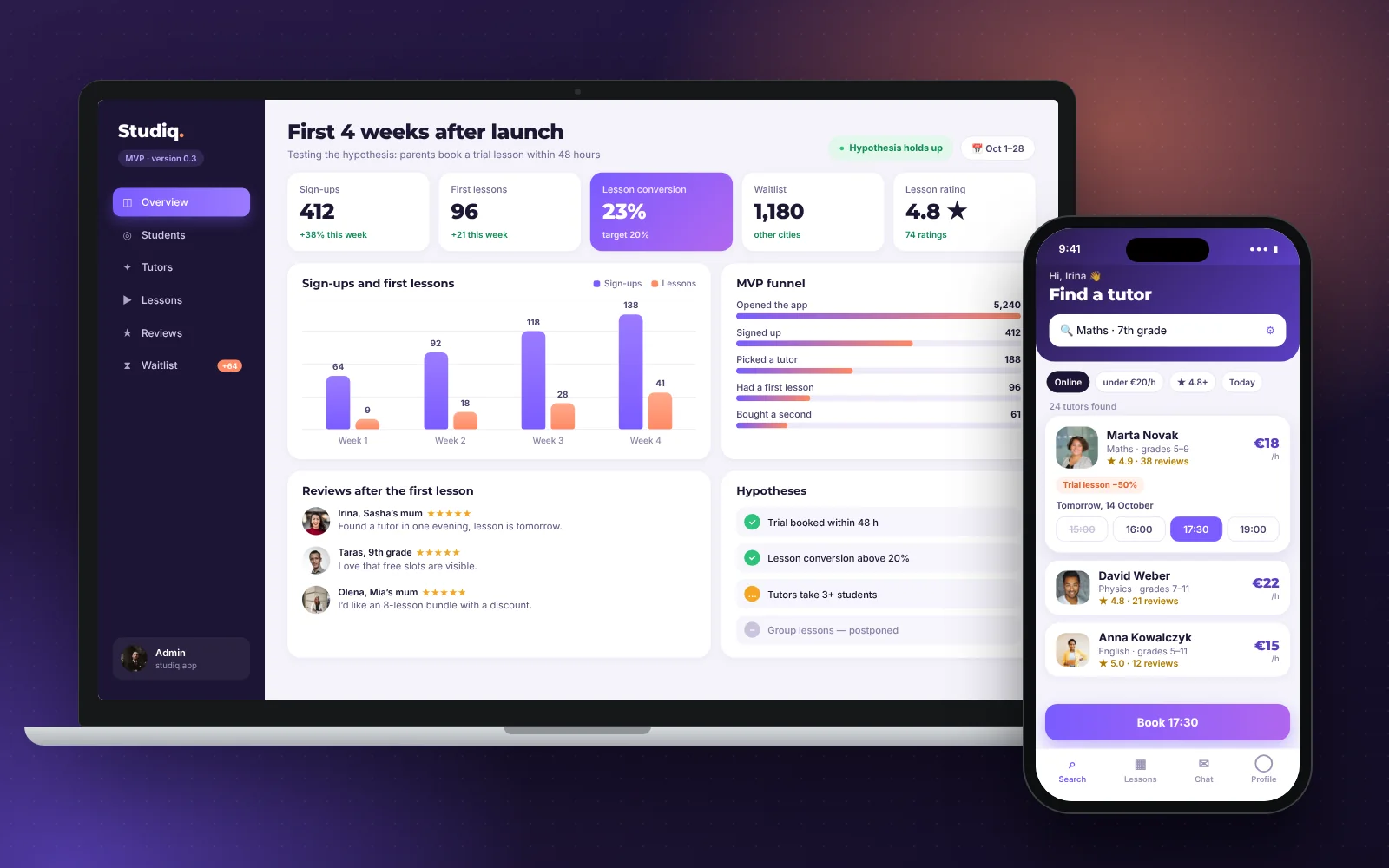
- State the hypothesis. "Owners of small clinics are ready to pay €50 a month for online booking" can be tested. "People like convenience" cannot.
- Set the success metric before launch. For example: 50 leads in a month or 10 paying customers. Without it you will bend the conclusion to fit.
- Describe the main user path. From first touch to result, in 3–5 steps.
- Draw and test. Screens, a clickable prototype, 5–7 showings to people from the audience.
- Build. Only the must-have features. We give preview links for each stage.
- Launch to a small group. The first 20–50 users: invite customers you know, give a discount for feedback.
- Measure and decide. Metric reached: expand. Not reached: change the hypothesis, do not add features.
If you are not yet sure you are ready for such a project in terms of team, budget and idea, write to us on the contact page and we will help you pick a format.
How to tell that an MVP worked
The success of an MVP is not the number of downloads but a confirmed hypothesis. Look at behavior, not opinions.
- Do people come back. One use proves nothing; repeat use already says something about value.
- Do they pay. Money, a pre-order or a letter of intent is more honest than "I like it".
- What acquisition costs. If one customer costs more than they bring in, you cannot scale.
- Where they drop off. At which funnel step people leave: that is exactly where the next version should invest.
- What they ask for. Repeated customer requests will suggest the second version better than any plan.
This takes analytics: installs, retention, funnels and revenue. We connect it to the app (from €590). For websites, visit analytics and goals are enough. If you run ads, see also the article on how much Google Ads cost and how to count the budget.
Typical mistakes when launching an MVP
- Too many features. The more features, the longer the timeline, the higher the budget and the weaker the conclusions.
- No metric. After launch it is unclear whether it is a success or not.
- Testing only on friends. They are polite and will say "great". You need strangers from the target audience.
- Taking technology "for growth". A complex architecture for a million users at the start is wasted money. But a "throwaway solution" with no room to grow is also a mistake: the foundation must handle added modules.
- Mixing roles. The client is the specification, the manager and the tester at once: the project stalls. Name one person who makes decisions.
- Not securing ownership. The code, domain and accounts must be yours. How to vet a contractor is described in "How to Choose a Web Development Company".
When an MVP starts with an architecture session
A landing page, a bot or a PWA launches without long preparation. But if your product is a system with several roles, payments, accounts or math inside (a SaaS, a marketplace, a CRM, scoring), then before writing code you need to answer these questions: which entities exist in the system, how they are connected, what goes into the first version, and what it costs.
For this we run an architecture session at €3,500: in 2–3 weeks you get a product map, an estimate and a plan for the first version. The cost of the session is credited toward the project, and the result stays with you even if you decide to work with another team. For more on how a SaaS is built and the most common mistakes, read "How to Build a SaaS".
We assembled examples of such systems in the GRONO, duck.credit and Discovery School projects: each began with discovery, then a first version, then new modules.
What to choose in your situation
- If you are not sure the idea is needed, start with a landing page at €790 or a quiz landing page at €890 and run ads on a small budget. It is the cheapest test.
- If your audience is in Telegram, take a bot at €890 or a Mini App from €3,900. The user has nothing to download.
- If you already have a site and need a "mobile service", take a PWA at €2,490.
- If you need an app in the App Store and Google Play, an MVP from €10,900 in 6–8 weeks. Store review is outside the timeline.
- If you need a platform with accounts and roles in your country or a SaaS, first an architecture session at €3,500, then a platform base from €17,900 or a SaaS service from €44,900.
- If you do not know which format fits, see the comparison "App vs Website".
The scope and prices of an app are on the iOS + Android app page, and other benchmarks are on the pricing page. We register everything in your name and say honestly what the first version will not have.
Frequently asked questions
What is an MVP in plain words?
An MVP is a minimum viable product: a first version with one main function that you can already show to real customers. Its goal is to test whether people need the product before you spend a large budget on the full version.
How much does an MVP cost?
It depends on the format. A landing page to test demand starts at €790, a Telegram bot is €890, an app from your site is €2,490, an iOS + Android app starts at €10,900 and a platform base at €17,900. Complex systems start with a €3,500 architecture session, which is credited toward the project.
How is an MVP different from a prototype?
A prototype shows how the product will look, but nothing works behind the buttons. An MVP is a working product with limited features that real customers use. A prototype tests whether the interface is clear; an MVP tests demand.
How long does it take to develop an MVP?
A landing page takes 2–5 days, an iOS + Android mobile app 6–8 weeks and a platform base from 6 weeks. Apple and Google review is not included. Timelines hold if the brief and materials are ready before the start.
Do I need an MVP if the idea is obvious?
Even obvious ideas are worth testing with a small step. If you have a site and customers, it is often enough to add one module. If you are building a product from scratch, an MVP lowers the risk of spending the budget on features that are not needed.
Can an MVP later grow into a full product?
Yes, if the base is built in modules. We assemble products from blocks, so payments, an admin panel, analytics or new roles can be added to a working version without rewriting. Check in advance that the code belongs to you and supports growth.
Why is an architecture session needed?
For complex systems it replaces guesses with a plan: a product map, a list of entities and links, an estimate and a plan for the first version. The €3,500 cost is credited toward the project, and the result stays with you in any case, even if you choose another contractor.
Which metrics show an MVP's success?
Whether users come back, whether they pay, what customer acquisition costs and at which funnel step people leave. Set the success metric before launch so you do not bend the conclusion to fit the result.
Sources
- MVP, prototype and proof of concept: differences and use cases · Svitla Systems
- An MVP is a test, not a product · Holub
- App development cost (market overview) · TechnBrains
- App Store Review Guidelines · Apple