
Website, PWA, Mini App or app: a comparison table
"App or website" is actually not a choice between two options but between four. Between an ordinary website and an app in the store there are two in-between formats, and they are often the sensible choice. Here is the comparison at YARDOS prices.
| Format | Price | Where it lives | Who it suits |
|---|---|---|---|
| Business website | €2,490 | Browser, Google search | Attracting customers from search and ads |
| App from your website (PWA) | €2,490 | An icon on the phone screen | Regular customers who need quick access |
| Telegram Mini App | from €3,900 | Inside Telegram | Booking, orders and a catalog for customers in the messenger |
| iOS + Android app | from €10,900 | App Store and Google Play | Services with frequent use, the camera, offline mode, payments |
If you do not know where to start, the rule is: go from cheap to expensive. A website is the foundation for everything else. Then add a format when you see that customers lack it. What an app costs in full is covered in "App Development Cost".
The main difference between a website and an app
A website opens from a link in any browser. It is found in Google, and you can click through to it from an ad without installing anything. That is a huge advantage: the path from interest to a lead takes seconds.
An app has to be found in a store, downloaded, opened and signed into. Each of these steps loses some users. In return you get a permanent place on the phone screen, notifications, access to the camera, location and other device features, and work without a connection.
What this means for a business
- New customers almost always arrive through the website, search and ads. For them an app is too high a barrier.
- Regular customers gladly use an app if it saves time: an order in two taps, purchase history, bonuses.
- SEO. A website brings traffic from search. An app does not do this by itself; it has to be promoted separately in the stores.
- Updates. A website updates instantly. An app goes through store review with every new version.
That is why most businesses get a website first and only then (if there is a reason) an app. If you do not have a website yet, begin with the steps in "How to Make a Website for Business".

When a website is enough for a business
A website is enough if most of these hold:
- customers find you through search or ads and leave a request;
- buying or booking comes down to filling in a form or making a call;
- the customer comes back rarely (a few times a year), not daily;
- you do not need phone sensors: the camera, Bluetooth, background notifications;
- you would rather spend the budget on growth than on developing a new format.
This is true for most services, B2B companies, experts, clinics, lawyers, manufacturers and small shops. For them a modern responsive website that looks good on a phone covers most of the tasks people attribute to an app. All the more so because many customers in your country first look for a company in search.
If you are choosing between a builder and custom development for the site, the comparison is in "Website Builder vs Custom Website".
PWA vs native app: what is the difference
A PWA (progressive web app) is a website that can behave like an app. It can be installed on the phone screen, opens without an address bar, stores some data to work on a weak connection and can send notifications. The basics of the technology are described in the web.dev course. A native app is a program installed from the App Store or Google Play that runs directly in the operating system.
What a PWA does well
- No store review and no developer account fees.
- One codebase for all devices, and updates go out instantly.
- Noticeably cheaper: our PWA built on your site is €2,490.
- People arrive by a link from an ad, a QR code or a newsletter and can add an icon to the screen.
Where a PWA falls short
- On iPhone, notifications work only after the user has added the site to the Home Screen (iOS and iPadOS 16.4 and later) and allowed them with a tap; in a regular browser tab there are no notifications (Apple documentation).
- You do not appear in app store search.
- Access to some device features is limited compared with a native app.
- Many people are used to looking for apps in the store, where trust and ratings are easier to work with.
What to choose
If you need quick access, notifications and a nice interface on the phone without a budget for the stores, start with a PWA. If you need heavy device features, a presence in the stores or paid subscriptions inside the app, take a full app. Note also that Apple does not accept apps into the App Store that are simply a "packaged website" with no features of their own (rule 4.2), so a plain wrapper around a website may not pass.
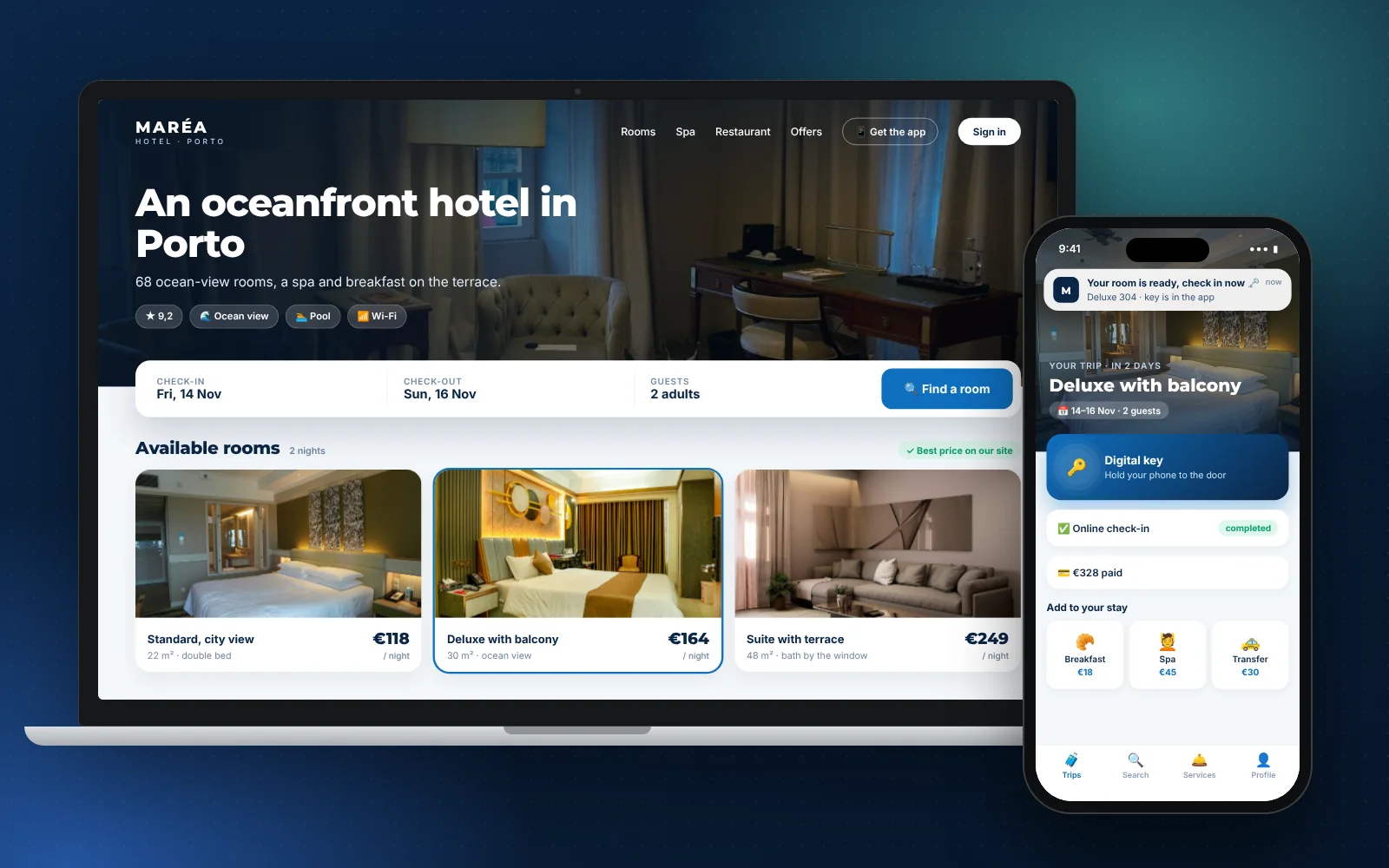
When you cannot do without an app
An app pays off when at least two or three of these conditions are met:
- Frequent use. The customer opens it once a day or more: food ordering, fitness, learning, banking, delivery.
- Notifications are essential to the service. A reminder, an order status, a message from a specialist.
- You need phone features. The camera, a scanner, geolocation, Bluetooth, working without internet.
- You need your own "environment". A profile, history, points and closed content in one place.
- The store as a channel. You expect some customers to find you in the App Store and Google Play.
- The app is your product. A startup whose service works only on the phone.
If you are a startup and the app is your product idea, do not try to build everything at once. First test demand on a minimal version. What an MVP is and what a launch costs is in "What Is an MVP and How Much Does It Cost", and the path from idea to publishing is in "How to Make an App".
Website, PWA or app: what you need
- Customers use the service more than once a week
- I need push notifications (order status, reminders)
- I need the camera, a scanner, Bluetooth or background location
- The service must work without internet
- I need a personal account with history, points and closed content
- I want customers to find me in the App Store and Google Play
- The app is my product, not a channel for the website
- My development budget is €10,000 or more
Flutter vs React Native: what to build the app with
If you have chosen an app, a technical question comes up that clients often ask too: what to write it in. A frequent search on this topic is Flutter versus React Native. You do not need to understand the details, but it is useful to grasp the gist.
Both are ways to write one codebase from which apps for both iPhone and Android are built. That is faster and cheaper than making two separate apps. Flutter is developed by Google and uses the Dart language and its own interface rendering (flutter.dev). React Native is based on JavaScript and uses the platform's native interface elements (reactnative.dev).
The honest answer
For most business apps both technologies fit, and the user will not notice the difference. Other things decide: the team's experience, ready libraries for your tasks, the ability to find specialists for support, the cost of maintenance. So do not choose by online reviews, where authors often defend "their" technology.
What to ask the contractor:
- What will you build the app with, and why exactly that?
- Will the code belong to me, and can other developers maintain it?
- Do you have experience publishing such apps to the stores?
Separate native development (Swift for iOS and Kotlin for Android) is needed for heavy graphics, complex sensor work, or when a product needs the newest platform features on the day they come out. For everything else one codebase is simpler and cheaper.
How to grow from a website to an app without extra spending
The safest scheme looks like a ladder where each step tests demand for the next.
- Website. You get an address you can give in ads, to the bank and to partners. You collect leads and see what customers ask.
- PWA or Mini App. The site gets a home-screen icon and notifications, or the service moves into Telegram. You see whether people come back and use the convenience.
- App in the stores. If regular use is confirmed, it makes sense to invest in a full app. By then you already have scenarios, texts, design and data, so development goes faster and more precisely.
This path does not throw money away: texts, brand style and the back end are reused at every step. That is exactly why we assemble products from modules instead of "from scratch" for each case: the business grows as demand is confirmed, not on bold forecasts.
Common mistakes when choosing
- "All our competitors have an app, so we need one too." Look at how many downloads and reviews they have. Sometimes an app exists and only a handful of people use it.
- Starting with an app and skipping the website. Without a site you will not be found in search, and banks and partners will not see your company.
- Ordering a website wrapper for the store. Such apps risk failing Apple's review and give the user little.
- Not counting costs after launch. Store accounts, updates for new iOS and Android versions, support and promotion. Plan for them from the start.
- Choosing the technology before the task. First decide what the product has to do, then choose the format and tools.
What to choose in your situation
- If you are opening a company or launching a service, start with a website. It is needed for the bank, partners and customers, and the app can wait. For a quick start there is the Website in 24 hours.
- If you already have a site and customers come back, add a PWA at €2,490: a home-screen icon and notifications without the stores.
- If your customers talk to you in Telegram in your city, look at a Mini App from €3,900: booking, a catalog and payment right in the messenger.
- If you are a startup and the app is your product, build an MVP from €10,900 and test demand.
- If you need a complex system with accounts and roles, start with an architecture session at €3,500 (the amount is credited toward the project).
- If you are not sure, write to us on the contact page and we will say honestly which format fits.
How to pick a contractor for any of these formats without mistakes is in "How to Choose a Web Development Company", and prices for all formats are on the pricing page.
Frequently asked questions
What is better for a business: an app or a website?
To attract customers from search and ads a website is better: it opens from a link and is indexed by Google. An app is needed when customers use the service often and you need notifications, the camera or offline mode. Most often a website is made first and the app is added later.
How is a PWA different from a regular app?
A PWA is a website that can be installed on the phone screen. It needs no app stores and costs less, but it falls behind a native app in device features and does not appear in store search. On iPhone, notifications work only after the site is added to the Home Screen.
How much does an app cost compared with a website?
With us a business website is €2,490, a PWA built on a site is €2,490, a Telegram Mini App is from €3,900 and an iOS + Android app is from €10,900. The domain, third-party subscriptions and store accounts are paid separately.
Can I just turn my website into an app?
Yes, as a PWA the site is installed on the phone like an app. But a wrapper alone is not enough for publishing in the App Store: Apple requires an app to offer more than a packaged website.
Which should I choose, Flutter or React Native?
For most business apps both technologies fit, and the user will not notice the difference. Decide by the team's experience, ready libraries and ease of support. Ask the contractor why they choose that technology and whether the code belongs to you.
Do I need an app if my customers are in Telegram?
Not necessarily. A Telegram Mini App works inside the messenger: the customer downloads nothing, and you get a catalog, booking or payment in a familiar interface. It is cheaper and faster than a separate app.
When is it time to move from a website to an app?
When you see customers returning regularly, asking for notifications, needing phone features (the camera, geolocation) or a closed account with history. Until then it makes more sense to invest in the site, SEO and ads.