
What Makes Up the Cost of Google Ads
Google Ads is search advertising: your ad appears next to search results when a person types a relevant query, and you pay only when they click the ad (known as pay-per-click, or PPC). So the question “how much does it cost” has two answers.
- The ad budget. The money you pay Google for clicks. There is no minimum required for everyone: you set a daily limit yourself. We do not take this money and add no markup: the budget goes directly to the platform, and the ad account is registered to you.
- The specialist’s work. Setup, keyword selection, ads, lead tracking and monthly optimization. With us, managing one channel, Google Ads or Meta, costs from €490 a month, with a two-month minimum. A second channel is paid separately.
Why a two-month minimum? In the first weeks the system is learning, and the main optimization falls in the second month. Stopping after two weeks means spending the budget and drawing no conclusions.
How the cost per click is formed
Ads compete in an auction, but the winner is not simply whoever pays more. Google evaluates “Ad Rank”: your bid plus the quality of the ad, its relevance to the query and the usability of the page the click leads to. Google’s help center says plainly that higher-quality ads often get a lower cost per click. So a weak website makes ads more expensive, and we check the page before launch.
How to lower the cost per click
What helps: precise keyword phrases instead of general ones, negative keywords (words for which the ad should not show, such as “free” or “download”), an ad that repeats the wording of the query, and a page where the person sees the answer right away. Change one parameter at a time and look at the cost per lead, not only the cost per click: a cheap click without a lead is worse than an expensive one with a lead.
How Much Does a Click Cost: Public Benchmarks
There is no single cost per click. It depends on the niche, country, city, time of day and competitors. So you are not guessing, look at the public LocaliQ (formerly WordStream) search advertising report for April 2025 to March 2026, which covers thousands of Google Ads and Microsoft Ads campaigns across 20 industries:
- the average cost per click across all industries is about $5.42;
- industries differ several times over: clicks and leads cost the most in legal services;
- the average conversion rate to the target action is around 7–8%;
- the average cost per lead is about $67.
The caveats matter. This is mostly US market data: click costs in your country can differ noticeably, often downward. The report shows averages for groups of industries, and your specific niche may be more or less expensive. And the conversion rate depends on the site: the same clicks on a good page and a bad page produce very different numbers of leads.
The real cost per click for your queries is shown by the Keyword Planner inside Google Ads itself. At the brief we check it and only then name a minimum budget. Quoting a cost per click in advance, without looking at the queries, would be dishonest.
How to Calculate Your Ad Budget
Calculate from leads, not from a sum you “don’t mind spending”. The formula is simple:
- Decide how many customers a month you need.
- Divide by the share of leads that become a sale. If one lead in five closes, 6 customers require 30 leads.
- Divide the leads by the site’s conversion rate. At 6%, 100 clicks give 6 leads, so 30 leads need about 500 clicks.
- Multiply the clicks by the cost per click. At €3 a click that is €1,500 a month.
In the calculator below you enter your own numbers and immediately see clicks, leads, sales, cost per lead and ROAS (return on ad spend). The defaults are based on the LocaliQ benchmark but with a cautious assumption: a 6% conversion rate, below the report’s average.
Ad budget, leads and payback
Benchmarks: the public LocaliQ report (2026) puts the average cost per click in search at about $5.42 and the average conversion rate at around 7–8%, mostly US data; we assume a cautious €3 and 6%. Enter the numbers for your niche. Ads are paid to the platform directly, and our management is from €490 a month on top.
Google Ads vs Facebook Ads: Which to Choose
These are different tools, not competitors in the same weight class. Google Ads works with demand that already exists: a person searches for “order a website” or “dentist near me”, and you appear at the right moment. Leads are usually warmer, but clicks cost more. Meta (Instagram and Facebook) shows ads to people who were not looking for you but resemble your customer. A click is often cheaper, but the person came “just to look”, and you have to earn the conversion with creative and an offer.
How to choose
- Demand already exists and people search for your product: start with Google Ads.
- The product is new or visual and people do not know it exists: Meta fits.
- You sell an expensive B2B service: Google Ads, because a query shows intent.
- You want reach and awareness, not only leads: Meta, plus social media content.
Specific click prices on Meta depend on the niche, format and country, and public benchmarks differ widely, so we do not give a single figure. In practice people often start with one channel, work out the cost per lead and only then add the second. Our packages follow the same logic: one channel of your choice.
What Is a Good ROAS
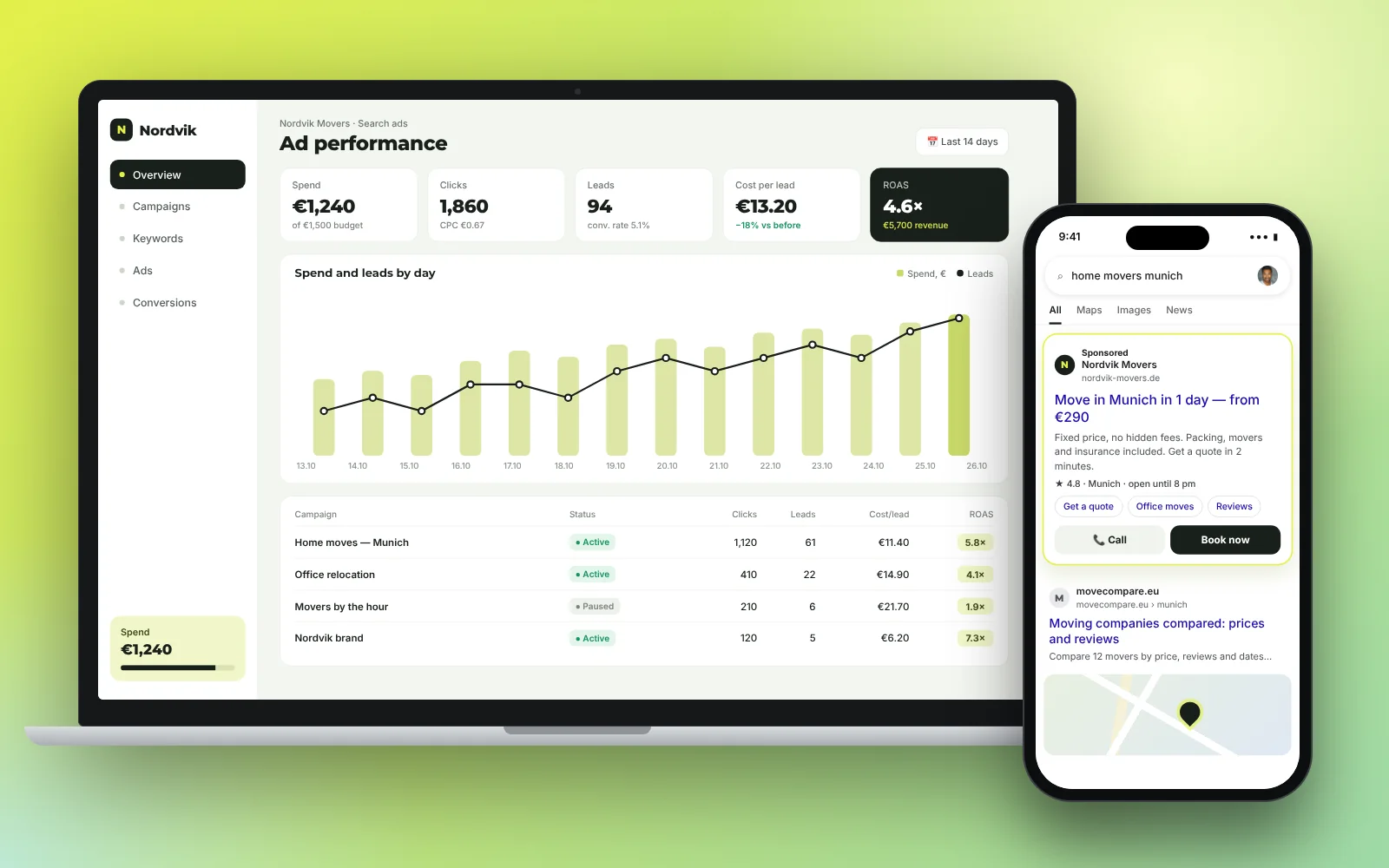
ROAS (return on ad spend) is the revenue from ads divided by the ad spend. If you spent €1,000 and got sales of €3,000, ROAS is 3, or 300%. The question “what is a good ROAS” has no universal answer, because it depends on your margin.
Work out your own break-even point
Divide 1 by your gross margin. At a 40% margin, break-even ROAS is 2.5: every euro of advertising must return €2.50 of revenue for you to break even. Anything above that is profit. At a 20% margin, break-even ROAS is already 5, and advertising is harder. This is one of the most important calculations: many campaigns look successful by the “good ROAS” figures in articles but lose money at your margin.
What else to consider
- Repeat purchases. If a customer comes back, you can be more lenient about the payback of the first order.
- Cost per lead versus cost per sale. With complex services a lead does not turn into a customer right away, and ROAS shows up weeks later.
- The cost of the specialist’s work. It should also be counted in the overall payback.
What to Do Before Launching Ads
Advertising amplifies what you have. If the site is weak, ads will show it quickly and expensively. Check four things:
- The page the click leads to. A separate landing page for the query is better than the home page. What a landing page is and how it is built is explained in our article on the converting landing page, and the price of a site in how much a website costs.
- Lead tracking. Form submissions, calls and messenger messages must be recorded in analytics. Without that you are paying blind.
- Speed and mobile version. A large share of clicks come from phones, and a slow page loses money.
- A quick reply to a lead. A lead that is answered after a day is often already lost. An auto-reply and a messenger bot help.
If you have no site yet, the quickest way to launch is a landing page for €790 (2–5 days): see the landing page.
Mistakes and Red Flags When Ordering Ads
- The account is registered to the agency. Ad accounts, pixels and analytics must belong to you. If you leave, the history stays with you.
- A commission hidden in the budget. Ask whether you pay Google directly, and ask to see spend in the account itself.
- A guaranteed number of leads. An honest contractor guarantees transparency, goals, tracking and a report, not a result that depends on the market.
- A report about clicks and impressions, but no leads. Clicks are not the goal. The goal is the cost of an inquiry and of a sale.
- Ads that never get paused. No review of which queries bring no leads and what was switched off.
The general principle for choosing a contractor is the same as for a website: ask for the scope of work, a sample report and client contacts. Details are in how to choose a web agency and avoid mistakes.
With us the report arrives every two weeks, the accounts are registered to you, and the terms are stated before the start. We manage only Google Ads and Meta, and we say so at the brief.
Another common mistake is changing settings every day. Advertising learns from data, and changes that are too frequent disrupt the learning. A sensible rhythm is to look at the report once every one to two weeks, make decisions based on the trend and make no more than a couple of noticeable changes at a time, so you understand what worked.
Ads, SEO or AI Search: What to Launch First
Ads bring leads quickly, for as long as you pay for them. Search engine optimization builds traffic that stays but takes months: details and prices are in how much SEO costs. For most small companies it makes sense to start with ads where leads are needed in the coming weeks, and to build SEO at the same time as a long-term asset. Campaigns in your city can be limited to a radius, so the budget is spent only on people who can actually come.
How to read an ad report
A report should contain five numbers. Clicks: how many people came. Leads: how many of them left something. Cost per lead: the budget divided by leads. Cost per sale: taking into account the share of leads a manager closes. ROAS: revenue to spend. Other metrics such as impressions and CTR (the share of impressions that become clicks) are for the specialist to understand what to fix. If the report has only those and no cost per lead, you are looking in the wrong place. Leads in your country and in other regions should be counted separately if you advertise in several places, since the cost per click differs everywhere.
What to Choose in Your Situation
- An ad budget under €500 a month. Choose one channel, narrow queries and limit the geography. There is not enough money for more queries.
- The site is weak or missing. The page first, ads second. Otherwise you pay for clicks that do not turn into leads.
- Demand already exists and you need warm leads. Google Ads, management from €490 a month: Google and social media ads.
- The product is new and visual. Start with Meta and test several creatives.
- You do not know where leads come from. First set up analytics and reports from €590: without them any advertising is blind.
- You want to scale. Add a channel only after the first one is calculated to pay back.
All prices are on the Pricing page.
Frequently asked questions
How much does it cost to set up and manage Google Ads?
Managing one channel, Google Ads or Meta, costs from €490 a month with us, for engagements of two months or more. You pay the ad budget to Google directly, and we do not mark it up.
What is the minimum budget for Google Ads?
There is no mandatory minimum, and you set the daily limit yourself. A sensible budget depends on the cost per click and the number of leads you need: at the brief we calculate it from your queries rather than naming a number at random.
How much does a click cost on Google Ads?
According to the 2026 LocaliQ report, the average cost per click in search is about $5.42, and industries differ several times over. The data is mostly for the US, and in your country and niche the price may differ.
Which is better, Google Ads or Facebook?
Google Ads catches demand that already exists, and leads are usually warm. Meta shows ads to people who were not looking for you and suits new or visual products. Many businesses start with one channel.
What ROAS counts as good?
There is no universal value. Divide 1 by your gross margin: at a 40% margin, break-even ROAS is 2.5. Anything above is profit, anything below is a loss.
How soon will the first leads arrive?
The first clicks and leads appear on the day of launch, but the main optimization happens in the first two months. So judge the result not by the first week but by the cost per lead after 6–8 weeks.
Who owns the ad accounts?
You do. Accounts, pixels and analytics are registered to you, and we get access as a contractor. If you decide to leave, the whole history stays with you.
Can I run ads myself?
Yes, especially with a small budget. You need a contractor when you lack time, the niche is competitive or the ads no longer pay back. Make sure lead tracking is set up, because without it you will not understand the result.
Sources
- Search Advertising Benchmarks for Every Industry [2026 Data] · LocaliQ (WordStream)
- About Ad Rank · Google Ads Help
- What Are Good Google Ads Benchmarks In 2026? · Search Engine Journal