
Chatbot Development Cost: Prices for Bots and AI Assistants
A chatbot is a program that talks to a customer in a messenger or on a website: it takes requests, books appointments and answers questions. The price depends on how “smart” the bot has to be and which systems it connects to. Our price list (v0.4, in euros):
| What we build | Price | Timeline |
|---|---|---|
| Telegram bot: menu, requests, mailings | €890 | 5–7 days |
| WhatsApp bot through the official channel | €990 | depends on Meta account approval |
| Booking and payment bot: slots, reminders, prepayment | from €1,990 | by estimate |
| Shop bot: catalog, cart, payment | from €2,490 | by estimate |
| AI assistant for your website and messenger | €2,690 | 2 weeks |
| Sales bot: orders, booking, payment, CRM link | €2,990 | 3–4 weeks |
| AI assistant for employees, answering from your policies | from €2,490 | by estimate |
| Voice AI agent that answers calls | from €3,900 | by estimate |
A CRM link (so that every conversation and lead goes straight into your system) is added from €690. You edit texts and buttons yourself afterwards, without a programmer, and the bot and accounts are registered to you. For complex cases, the exact sum is calculated in an estimate after the brief.
AI Agent vs Chatbot: What Does Your Business Need
The words “bot”, “AI assistant” and “AI agent” are often mixed up, but they are different levels.
- A rule-based chatbot works with buttons and pre-written branches: “choose a service”, “leave your number”. It is predictable, cheap and does not make things up. It will not understand a free-form question outside its script.
- An AI assistant understands a question asked in the customer’s own words and answers from your materials: the website, price list, documents. If it is unsure, it hands the conversation to a person.
- An AI agent goes further: it not only answers but acts on its own, for example checks free time in a calendar, creates a booking, updates an order in the CRM. The more it decides by itself, the higher the cost of an error and the more carefully it must be tested.
Anthropic’s researchers draw a similar distinction in their guide “Building effective agents”: there are “workflows” with a rigid, predefined path and “agents” where the model itself decides which steps to take. They advise starting with the simplest solution and adding complexity only when it is really needed, because agents are usually more expensive and slower. The conclusion for business is the same: take the least clever bot that fits your task.
A simple rule for choosing
If customer questions repeat and fit into 10–15 variants, a rule-based bot is enough. If people ask in any way they like and the answers sit in your documents, you need an AI assistant. If something has to be done in your systems after the answer (book, change, invoice), an agent part is added, but with a human check at risky points.
An example with a beauty salon
A rule-based bot offers a choice of service and a time from free slots. An AI assistant answers the question “can I get coloring after a lamination treatment, and how long will it take” from your service descriptions. An AI agent also moves the booking if the client writes “can we do an hour later” and updates the stylist’s schedule. Each next level is more convenient for the client, but it also needs more checks and more money. For most small salons the first is enough, sometimes with the second.
How Much Does a Telegram Bot Cost
Telegram’s bot platform itself is free for both users and developers. You pay not Telegram but for the work of building the bot. A basic Telegram bot costs €890 with us: a menu, request collection (including bookings), mailings to your list and notifications to a manager. The timeline is 5–7 days from the moment we have the brief and materials.
What you can add
- Payment in the bot, prepayment or order payment by card: €690.
- Booking and reminders with free slots: €790.
- A catalog and cart with an order right in the messenger: €990.
- A control panel where you change texts, scripts and mailings: €990.
- Handing a conversation to an operator: €490.
- Another channel (WhatsApp, Viber, Instagram or website chat) with the same bot: €590 per channel.
- Another language: €290 per language.
If you choose three or more add-ons, a 10% bundle discount applies in the configurator on the Telegram bot page. Telegram is very popular in some markets, while in Europe, the US and the UK customers more often use WhatsApp or website chat, so look at where your customers talk in your country.
Which Tasks a Chatbot Handles Best
Not every business needs a bot, but in some scenarios it brings noticeable benefit in the first month:
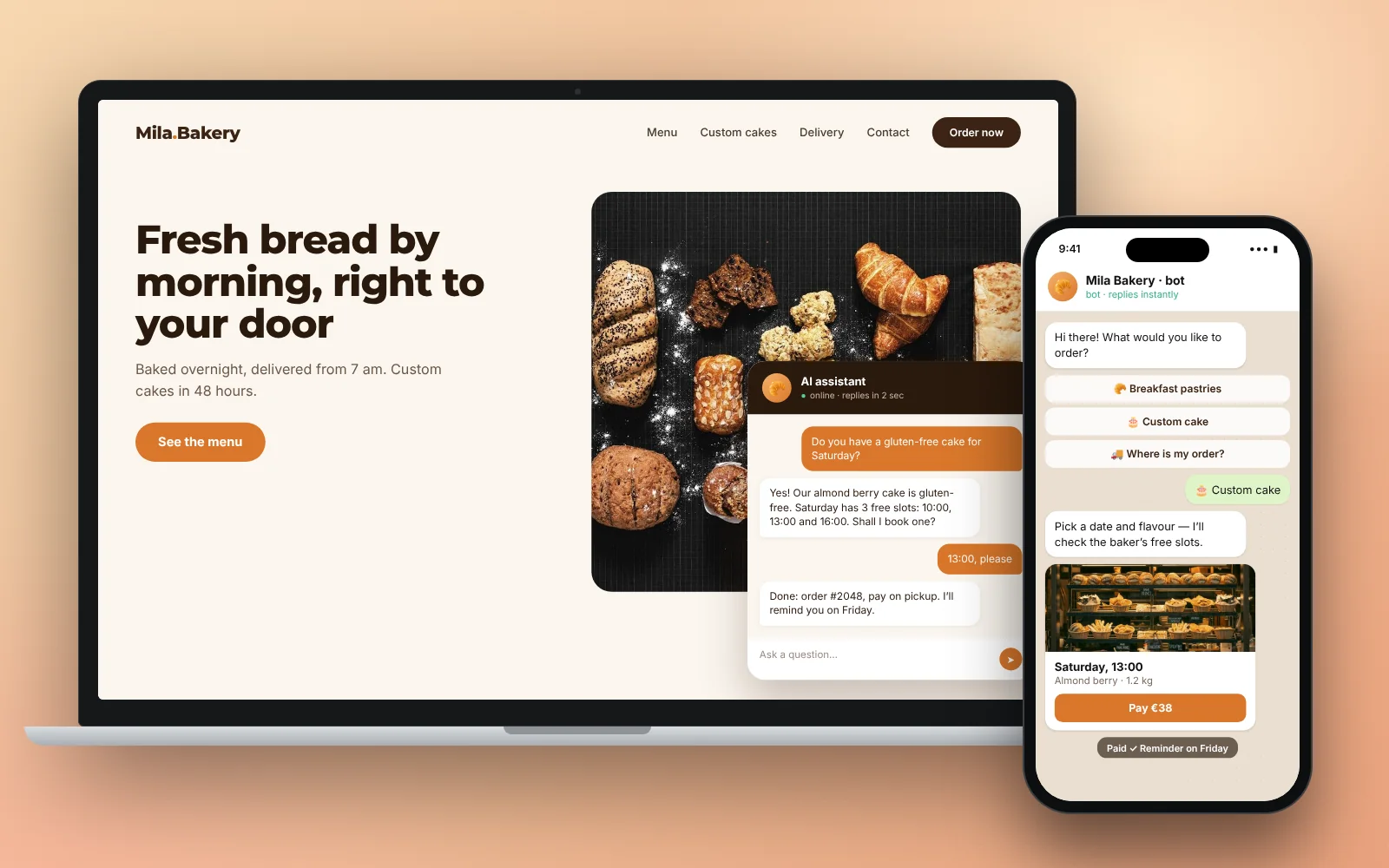
- Appointment-based services (clinics, salons, freelancers, consultants). The bot shows free slots, confirms the booking and reminds about the visit, which reduces no-shows.
- Online stores and small retail. A catalog, order status and answers to delivery questions take a noticeable share of routine off the manager. If you do not have a store yet, first read how to open an online store.
- B2B inquiries. The bot asks qualifying questions (budget, timeline, task) and passes the manager a prepared lead instead of “hi, how much is it”.
- Education and communities. Mailings, class reminders, answers about the schedule and rules.
- Internal tasks. A newcomer asks the bot how to request leave, where the policy is and how to file a request, and does not distract colleagues.
The common sign of good tasks: questions repeat, the answer can be written in advance, and response speed affects money. If it is the other way round, that is, every inquiry is unique and needs an expert decision, a bot can at most collect the contact and hand the case to a person.
What You Pay on an Ongoing Basis
The one-off development cost is not everything. A bot also has running costs, and it is better to know about them in advance:
- The AI model. AI answers are paid to the model provider based on usage, by the amount of text processed (tokens). The sum grows with the number of conversations.
- The messenger. Telegram is free, while on WhatsApp Business messages may be charged under Meta’s rules.
- Hosting and services. They often fit into free plans while there are few conversations, but as volume grows you will have to move to paid ones, and we will warn you in advance.
- Maintenance. Updating scripts, checking answers and limiting “made-up” replies take time.
You pay these directly, and we add no markup on infrastructure. If you are comparing our bot with ready-made subscription services, take their pricing model into account: for some (for example, Intercom with its Fin AI agent) the price depends on the number of “resolutions”, and as volume grows the costs grow in proportion. Check current rates on the service’s own page.
Will a Chatbot Pay Off: Working Out the Savings
A bot saves money when it takes over repetitive inquiries. Use the calculator below: how many inquiries arrive a month, what share the bot closes by itself, how many minutes an employee spends on one inquiry, how much their hour costs, what the development costs and the monthly running cost of the bot. You will see the monthly saving and the payback period.
The riskiest figure here is the share of inquiries the bot closes on its own. Do not believe promises like “the bot will close 80% of questions” until you have measured it on your own data. Distinguish “the bot replied” from “the question was resolved”: the customer may simply have closed the chat. Start with a conservative 30–40% and check it over the first month against real conversations.
There are also benefits the calculator does not see: an answer at night and on weekends, an instant reaction to a lead and customers you do not lose to long waits. If one extra lead a month brings you €500, that counts as payback too.
Will a chatbot pay off: savings on support
The defaults are a hypothetical example for an AI assistant (€2,690). You set the share of inquiries the bot closes by itself and the employee rate: check them against real conversations. The AI model and the messenger are paid separately, directly, based on usage.
AI Assistant: Limitations and Risks
An AI assistant can make mistakes. It answers from your materials, and we set it up so that when it is unsure it hands the question to a person, but errors cannot be ruled out entirely. That is why answers are tested on real questions before launch, and conversations are reviewed regularly after launch.
A separate word on data. A bot receives customers’ personal information, so you need to understand where it is stored and who sees it. We set up storage on your own accounts and take only what is needed to answer. We prepare the privacy policy and consents as a template, and a lawyer in your country does the review: for the EU and UK the GDPR matters, and other markets have their own rules.
And do not forget the boundary: a bot is good at typical questions, while difficult conversations, complaints and non-standard decisions should go to a person. A good bot does not replace the team, it relieves it.
Agree in advance on what counts as success: the share of resolved questions, response time, the number of leads collected. Without these goals, in three months you will not be able to say whether the bot helped, and decisions about developing it will be made on feelings rather than data.
How a Launch Works and How to Choose a Contractor
- Brief and scripts. Together we decide which customer questions the bot closes and which it hands to a person.
- Knowledge base. For an AI assistant we collect the website, price list and documents it learns from.
- Build and tests. You get a link to a working bot and test it on real questions.
- Launch. We connect the channels, the CRM and team notifications.
- Monitoring. For the first weeks we review conversations and correct answers.
When choosing a contractor, ask the same questions as when ordering a website: what is included in the price, who owns the accounts and the bot, what the reports look like and what happens if the AI makes a mistake. A detailed checklist is in how to choose a web agency and avoid mistakes. A red flag is a contractor who promises “the bot will answer everything”.
What to Choose in Your Situation
- You need to take requests and book clients. A Telegram bot for €890. If your customers are on WhatsApp, take the WhatsApp bot for €990.
- Customers keep asking the same questions on your site. An AI assistant for €2,690 answers from your materials and calls a person when needed.
- You need orders, booking and payment in the chat. The “sales bot” for €2,990, or a booking and payment bot from €1,990.
- Employees are drowning in questions about policies. An AI assistant for employees from €2,490.
- Leads must land in a CRM. Add a CRM integration from €690. Whether you need your own CRM is covered in custom CRM or off-the-shelf.
- You need a full app, not a chat. Compare the options in how much an app costs and app or website.
- Questions are few and simple. You may not need a bot yet: an FAQ page on the site is enough.
All prices are on the Pricing page.
Frequently asked questions
How much does it cost to build a Telegram bot?
A basic bot costs €890: a menu, requests and mailings, in 5–7 days. A booking and payment bot starts from €1,990, and a shop bot from €2,490. Telegram itself is free for developers and users.
How much does an AI chatbot for a website cost?
The AI assistant package costs €2,690: it learns from your site and documents, works on the website and in a messenger, and hands difficult questions to a person. The AI model is paid separately based on usage.
How is an AI agent different from a chatbot?
A rule-based bot works with pre-written branches, an AI assistant answers free-form questions from your materials, and an AI agent also performs actions: it books, updates an order. Start with the simplest level.
Will the bot make up answers?
AI can make mistakes. We set it up to answer from your materials and to hand the question to a person when it is unsure, and we test answers before launch. Errors cannot be excluded entirely.
Who owns the bot?
You do. The bot is registered to your account, the connected services are registered to you, and we work through access. If you decide to change contractors, the bot and its history stay with you.
What ongoing costs will there be after launch?
Payment for the AI model by the number of conversations, possible messenger fees (on WhatsApp Business) and hosting once the free limits run out. You pay these directly, and we add no markup.
Can the bot be connected to a CRM?
Yes, a CRM integration costs from €690: every conversation and lead goes straight into your system. The sales bot at €2,990 includes a CRM link.
Do I need a bot if I have a small business?
If there are few inquiries, a page with answers and a contact button is enough. A bot makes sense when the same questions repeat every day or leads are lost to slow replies.
Sources
- Bots: An introduction for developers · Telegram
- Building effective agents · Anthropic
- Telegram Bot API · Telegram
- Intercom pricing (the AI agent is billed per resolution) · Intercom