
Where to start: product, buyer and business format
An online store is not just a website with a cart. It is a chain: product, warehouse or supplier, payment, delivery, returns and support. The website is only the shop window of that chain, so you should start not by choosing a platform but with three questions.
1. What you sell and how you differ
If you offer the same as the marketplaces, only pricier and without reviews, your chances are slim. Strong starting positions: a narrow niche, your own production, an expert selection, products the big platforms do not carry, or convenient delivery in your city. Put into one sentence why a buyer will choose you.
2. Where the goods come from
Your own production, buying from a supplier into a warehouse, or order-based work (dropshipping: the supplier ships the product to the buyer). Stock, delivery times and legal duties depend on this. For a first store it is often wiser to start with a small range.
3. Which country and format you operate in
Business registration, taxes, mandatory texts on the site and buyers' rights depend on the seller's country and the buyer's country. Discuss these with an accountant or lawyer: we do not give tax or legal opinions, we only prepare template pages that your lawyer reviews. If you plan to sell in Europe from another country, take that into account when choosing where to register the company.
How to start an online store: 8 steps
- Test demand. Search for your product, look at competitors and prices, talk to your first buyers. You can start with sales through social networks and messengers to see what people buy.
- Set up the business. Choose a legal form (sole proprietor, company and so on in your country), open a business account and sort out taxes. The bank or payment provider will later ask for the site too; more in the article on a website for a bank and Stripe.
- Prepare the catalog. A table of products: name, description, price, photos, stock. Good photos and descriptions sell better than any design. Start with 20–100 products.
- Choose how to build it. A builder or platform, custom development, WordPress with plugins. Covered in the following sections.
- Connect payment and delivery. A payment provider (cards, Apple Pay, Google Pay or local methods) and 1–2 carriers with clear prices. You sign the contract with the payment provider yourself.
- Add legal pages. Privacy policy, terms of sale, returns and delivery, company details and contacts. Sellers from Germany and Austria also need an Imprint.
- Test an order end to end. A test purchase from a phone: cart, payment, email to the buyer, order in the admin, notification to you. This is how we check every store before launch.
- Launch and attract your first buyers. Social networks, ads, email, search. More on promotion below.
If this is your first website, it helps to read the general plan first: how to make a website for business step by step. Many steps are the same as for a store; only the catalog, cart and payment are added.

Ecommerce website cost: how much it costs to open an online store
The cost of a store is made of five items: development, payment provider and delivery, domain and services, content, and promotion. Below are the prices from our price list v0.4 (in euros) and honest caveats.
| Package | Price | Timeline | What is included |
|---|---|---|---|
| "Start" | €2,490 | 2–3 weeks | Up to 100 products, cart and order, orders in the admin, email to the buyer, 1–2 delivery methods, SEO base for the catalog |
| "Business" | €4,990 | 4–6 weeks | "Start", online payment (cards, Apple Pay, Google Pay), up to 1,000 products, filters and variants, buyer account, abandoned cart, promo codes, 2 languages and currencies, CRM link |
| "Premium" | from €12,900 | from 8 weeks | "Business", real-time stock, several warehouses, wholesale account, marketplaces and accounting systems |
What you need is added to "Start" as modules: online payment +€490, delivery services +€590, large catalog and filters +€790, buyer account +€990, an extra language and currency +€690 per language, marketplace export +€1,090 per platform. With three or more modules a 10% discount applies.
What you pay to others
- Domain. You pay the registrar directly; it is usually a small amount a year.
- Payment provider fee. For example, Stripe publishes a rate of 1.5% + €0.25 per payment for standard cards in the European Economic Area (as of the date of the article; other providers and countries differ, so check the current rate).
- Delivery. Carrier rates are paid by the buyer or by you.
- Hosting and services. At the start you may fit within free plans; when orders grow, we tell you in advance which plan is needed and what it costs.
What the first year costs
For a small store a realistic budget is development (€2,490–4,990), 1–3 months for content and launch, then promotion. Do not budget "only for the site": without traffic a store is empty. How much you need for search is in "How Much Does SEO Cost", and for ads in the piece on Google Ads.
Calculate your online store cost
- "Start" store (up to 100 products): €2,490 · 2–3 weeks
- "Business" store (up to 1,000 products, payment, account): €4,990 · 4–6 weeks
- "Premium" store (warehouses, wholesale, accounting systems), from: €12,900 · from 8 weeks
Add-ons:
- Online payment (only with "Start"): €490
- Large catalog and filters (only with "Start"): €790
- Buyer account (only with "Start"): €990
- Promo codes and abandoned cart (only with "Start"): €690
- Delivery services (1–2 carriers): €590
- Link to an ERP or accounting system: €3,790
Prices follow the YARDOS price list v0.4. "Business" already includes online payment, filters, a buyer account, promo codes and 2 languages: those modules are needed only with "Start". The domain, payment provider and delivery are paid directly, with no markup from us.
Shopify alternative: Shopify, a builder or your own store
This is the main question for a beginner seller, and the honest answer is that it depends on the task. We do not build sites on website builders ourselves, but that does not mean they are bad.
When Shopify and other platforms fit
A platform wins if you need a quick start without a developer, your range is simple and there are no special logic requirements. You pay a subscription: according to Website Builder Expert's 2026 review, Shopify plans start at roughly $29 a month when billed yearly and $39 month to month, plus payment fees and paid apps (check the current price list on the platform's website). For testing an idea that is fine.
When your own store pays off
- You do not want to pay a platform every month and give up a share of turnover.
- You need special logic: your own pricing rules, a wholesale account, a link to an accounting system, non-standard delivery.
- Speed and search optimization without theme limits matter.
- The code, customers and orders must belong to you and be stored with you.
Your own store is registered to you: repository, domain and accounts, no monthly fee to a platform, and the payment provider takes only its own fee. You pay once for development, plus the domain and any service plans you need as you grow. A detailed three-year comparison with a calculator is in "Website Builder vs Custom Website".
If your store is already on Shopify, Tilda or WordPress
We move products, customers, orders and page addresses to custom development so you do not lose search positions (from €1,490, store migration). But moving makes sense when you have hit limits or pay too much for subscriptions and apps, not just because "your own is better".
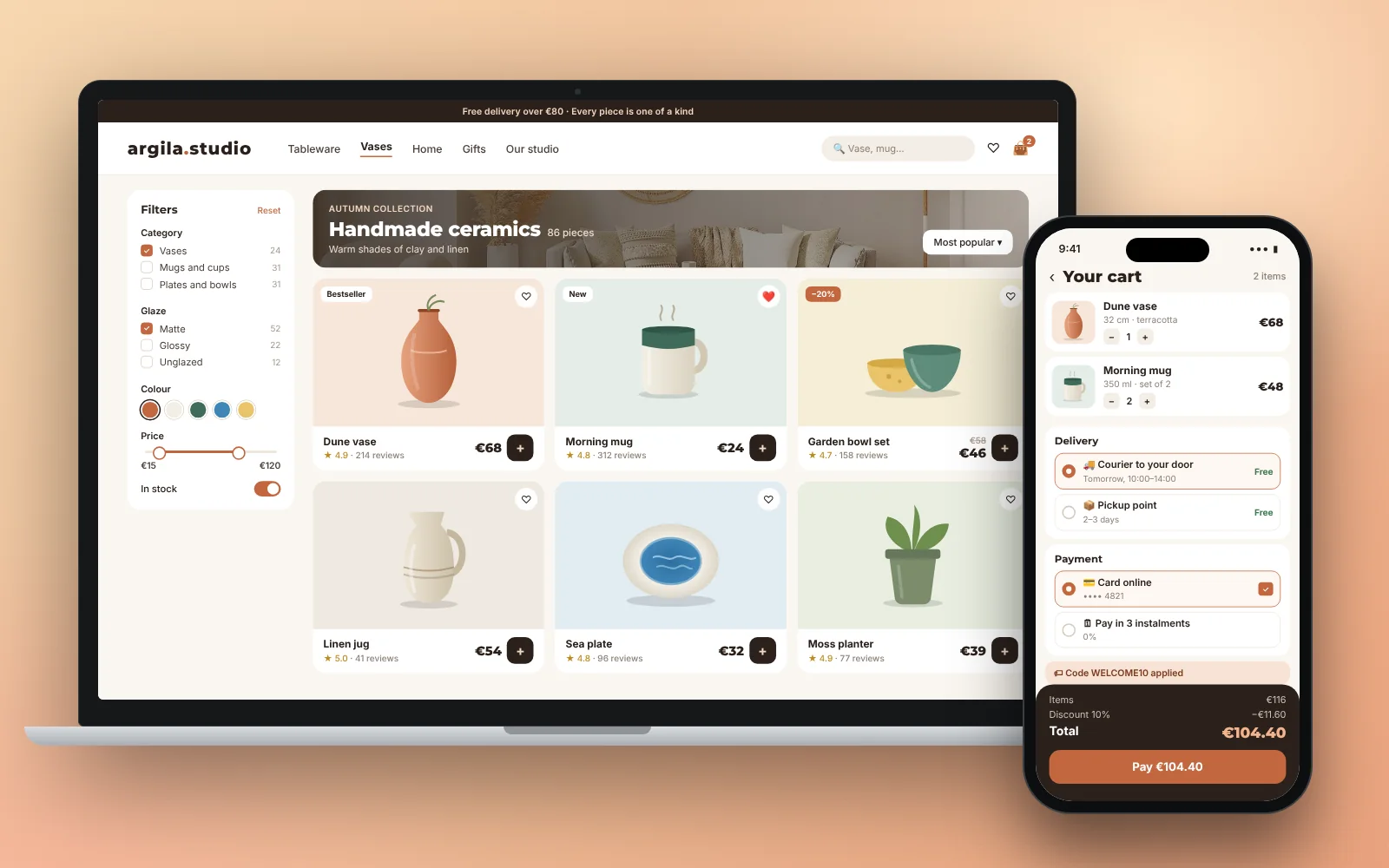
Payment, delivery and required pages
This is where beginners most often go wrong: the store is beautiful, but the bank does not approve payments and the buyer does not understand the return terms.
Payment
Choose a payment provider for your country and buyers: cards, Apple Pay, Google Pay, transfers, cash on delivery. The provider will check your business and site itself, which we cover in the article on bank and Stripe requirements for a website. Approval depends on the provider, not on us or the developer.
Delivery
Start with one or two carriers and fixed prices. In Europe, buyers are used to seeing the delivery cost and time before checkout. Connect a courier or pickup points in your city if they are available.
Buyer rights and legal pages
A buyer needs clear terms: price with taxes, payment and delivery methods, returns, contacts and company details. In EU countries, distance purchases carry a right to withdraw within 14 days without giving a reason, with a number of exceptions (for example, made-to-order or perishable goods); see the official Your Europe page. If you sell into the EU from the US or UK, these rules apply to your EU buyers, so check them with your lawyer. Sellers from Germany need an Imprint (legal information about the seller) with the company name, address and contacts; the German chambers of commerce explain it in detail. We prepare page templates for your jurisdiction, and your lawyer does the final check.
If your buyers are in different countries, plan for several languages and currencies: that is a module, not a separate project.
How to get your first buyers
Opening a store is half the task; the other half is getting people to know about it. The main channels:
- Search (SEO). Category pages and product cards for buyers' queries. Slow, but cheap over the long run. For a store we do SEO separately: categories, filters and cards (from €790 a month).
- Ads. Google Shopping and search ads bring buyers fast, but need a budget and analytics. The article on Google Ads will help you work out payback.
- Social networks and email. They work for repeat purchases and for niches with a visual product.
- AI search answers. Buyers increasingly ask ChatGPT and similar systems; how to prepare a site for that is in our article on getting into ChatGPT answers.
The result of promotion depends on the market, price and competitors, so we do not promise rankings or sales. We are responsible for the store being fast, clear and ready for search.
Typical mistakes when opening a store
- Design first, product second. No descriptions and photos, an empty site. Catalog first, styling second.
- Too wide a range at the start. 30 well-described products are better than 3,000 without photos.
- Hidden costs. Fees, apps, delivery and returns eat the margin you counted as "clean". Calculate everything before launch.
- No test order. The buyer discovers that the email does not arrive or the payment hangs. Check the whole chain from a phone.
- No legal pages. The payment provider or bank may refuse, and the buyer does not trust the store.
- No plan for attracting buyers. "We will open and they will come" does not work.
- Dependence on the contractor. The site is not registered to you. Insist that the domain, code and accounts are yours; a checklist for talking to an agency is in "How to Choose a Web Development Company".
What to choose in your situation
- If you are only testing an idea and have few products. Sell through social networks and messengers or take a platform on its lowest plan. Do not invest in development until you have first sales.
- If you already sell by hand and want orders in one place. The "Start" store at €2,490: up to 100 products, cart, admin, payment as a module.
- If you need a steady flow of orders, filters and a buyer account. The "Business" package at €4,990.
- If you have a warehouse, an accounting system or wholesale. "Premium" from €12,900 or a B2B catalog from €4,990.
- If your store is on a platform and you overpay. First calculate on a three-year horizon, then decide about moving.
- If you sell in several countries. Plan languages, currencies and legal pages for each country from the start.
- If you only need bank approval and payments. What matters more to you is a Website in 24 hours at €599, and the store can be added later.
If you need an exact price, build your store in the calculator above or write to us on the contact page. Work by the laws of your own country and discuss taxes and legal questions in your country with an accountant or lawyer.
Frequently asked questions
How much does it cost to open an online store?
Our "Start" store is €2,490, "Business" is €4,990 and "Premium" is from €12,900. You pay separately for the domain, the payment provider's fee and delivery. You can build the exact amount in the calculator by modules.
How long does it take to build a store?
"Start" takes 2–3 weeks, "Business" 4–6 weeks and "Premium" from 8 weeks. The timeline counts from the moment we receive the brief, the product catalog and access.
Do I need to register a company to open a store?
Usually yes, but the rules depend on the country and sales volume. Payment providers and banks check the business, so it is best to discuss registration with an accountant or lawyer before launch. We do not give legal opinions.
Which is better: Shopify or my own store?
Shopify is convenient for a quick start without a developer, but you pay a subscription and fees. Your own store needs a one-time investment, but there is no monthly platform fee and you can tune the logic flexibly. A three-year comparison is in our article on builders versus custom development.
Can I accept card payments?
Yes. We connect your payment provider (Stripe, PayPal or a local one) as a module from €490. You sign the contract with the provider yourself, and it decides whether to approve you for payments.
Which pages does a store need by law?
At a minimum a privacy policy, terms of sale, delivery and return terms, company details and contacts; in Germany and Austria also an Imprint. We prepare templates, and the client's lawyer does the final check.
Can I move a store from Shopify, Tilda or WordPress?
Yes, we move products, customers, orders and page addresses to keep search positions. Migration costs from €1,490, but first make sure that moving really pays off for you.
Do you promise sales and search rankings?
No. Sales depend on the product, price, competitors and ads. We are responsible for a working store, fast loading and readiness for search.
Sources
- Your Europe: the right to return a purchase within 14 days · European Commission
- Stripe: pricing for businesses in the European Economic Area · Stripe
- Shopify Pricing 2026: Plans and Fees Explained · Website Builder Expert
- IHK: Impressum, required information on websites (Germany, in German) · IHK Köln