
The difference between a website builder and custom development
A website builder (Wix, Squarespace, Webflow and similar) is a ready platform: you pick a template, drag blocks around and pay a subscription. The platform hosts your site, updates it and keeps the server running.
A custom website is built for your task from design and code. It lives on your own domain and accounts, and you do not pay a platform every month. In return, you pay for development once.
One thing to say right away: we build only custom websites and do not work on builders. So we are not trying to talk you out of a builder. It is a good tool for certain jobs, and below we show honestly which ones. If a builder is enough for you after reading this, we will say so.
A simple rule: a builder is renting, a custom site is buying. Renting is cheaper at the start and more convenient while your needs are simple. Buying pays off when you grow and when the site has to do something that is not on the platform's menu.
There is another difference that is rarely mentioned: who is responsible for the result. On a builder you are responsible for everything, from copy to page speed, and the platform's support only helps with the platform itself. When you order a site, part of the responsibility moves to the contractor, who checks the mobile version, speed, forms and emails before launch. For someone who does not want to dig into technical details, that can matter more than the price gap. If you are choosing a site for a company in your city, take this into account too.
What is a custom website
A custom website is a site whose design, structure and features are made for you rather than picked from a set of templates. It is not necessarily expensive or slow. With us, for example, a business card site costs €990 and takes 3–5 days, and a 10-page business website costs €2,490 and takes 10–14 days, because we assemble it from ready, proven blocks rather than writing it from scratch each time.
What you get
- A design built from your brief, not a template used by thousands of sites.
- Ownership. The domain, code and accounts are registered to you, and you can change contractors at any time.
- Speed. Pages without extra code open fast, which matters for search and for people.
- Any features. Payments through your own provider, a customer account, booking, a CRM link, multilingual setup with search tuning for each language.
- An editor. You change texts, photos and prices yourself; no programmer is needed for that.
What you do not get
There is no built-in platform: you are responsible for the domain and, if you want, for paid plans of third-party services. We name these costs in advance and add no markup on them. What a custom site costs for different kinds of projects is covered in "How Much Does a Website Cost in 2026".
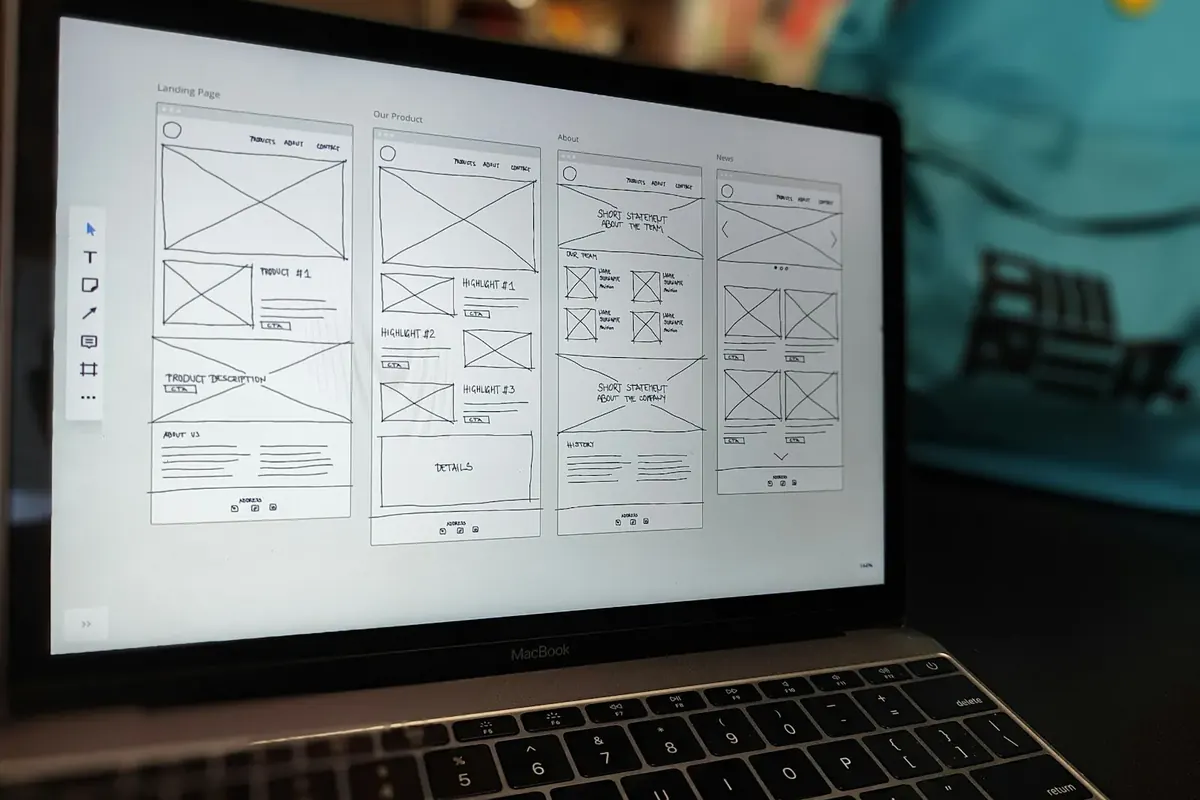
Custom website vs template: an honest comparison
| Criterion | Builder / template | Custom website |
|---|---|---|
| Start | Fast: you can build it in an evening if you have copy and photos | From 24 hours for one page, 10–14 days for a 10-page site |
| Payments | A subscription every month or year | One-time development fee, domain separate |
| Design | Limited to the platform's templates and blocks | Built for your task and brand |
| Features | What the platform and its app store offer | What you need: payments, account, CRM, roles |
| Google search | The basics are there; fine tuning and speed are limited | Full setup for your queries and languages |
| Ownership | The site lives on the platform; moving usually means a rebuild | The code and accounts are yours |
| Edits | You change everything yourself | You edit texts and photos; structure goes through the contractor |
| Risks | The platform changes prices and plans | You need a reliable contractor |
Reviews of builders and custom development (for example, iCoderz's comparison of Webflow, Wix and Squarespace) agree on the main point: a builder wins on speed and simplicity, a custom site wins on flexibility, ownership and room to grow. It is hard to argue with that, because it is true.
Price needs more careful handling. According to Domain.com, agencies charge from a couple of thousand dollars to $50,000 and more for a website, while paid plans of popular builders usually start at roughly $20–30 a month in reviews. Our packages are cheaper than most agency prices because we sell standard solutions with a fixed price. Compare not "a subscription and a development fee" but the cost over a period, which is the next section.
Cost of ownership over three years
A subscription of $20–30 a month looks almost free. But over three years it adds up, and it does not include the apps you will have to buy: for a form with a CRM, several languages, advanced analytics, appointment booking. According to the platforms' public price lists, a paid plan for a site on your own domain costs on the order of $15–30 a month when paid yearly. Exact numbers change several times a year, so check them on the platform's website.
In the calculator below you can enter your own numbers. We set realistic defaults: a subscription of about €30, paid add-ons of €25 a month, template setup of €500, our business website at €2,490 and €15 a month for paid services once the site outgrows free plans (hosting at the start is free with us, and maintenance is optional, from €49 a month). Change the figures for your case.
An example with the default numbers. Builder: €500 setup plus €30 subscription and €25 add-ons a month come to about €2,480 over three years and about €3,800 over five. Custom site: €2,490 for development and €15 a month for services come to about €3,030 over three years and about €3,390 over five. In the first years the builder is cheaper, by the fifth year the custom site is ahead, and the gap keeps growing. This is arithmetic on assumed numbers; yours will differ, so enter your own. If you add our maintenance at €49 a month, the builder stays cheaper even after five years on these numbers: then you choose by features and ownership, not by price.
What such a calculation shows in most cases:
- Over one year a builder is cheaper: you pay a subscription, not development.
- With the calculator's defaults the totals even out around year four or five.
- After that the custom site is cheaper, because the subscription keeps running while development is already paid for.
If you have a simple site with no add-ons, a builder may stay cheaper even after three years. We will not pretend otherwise. But a custom site has a second side: it is your asset, it can be sold with the business and developed without being tied to a platform's plans.
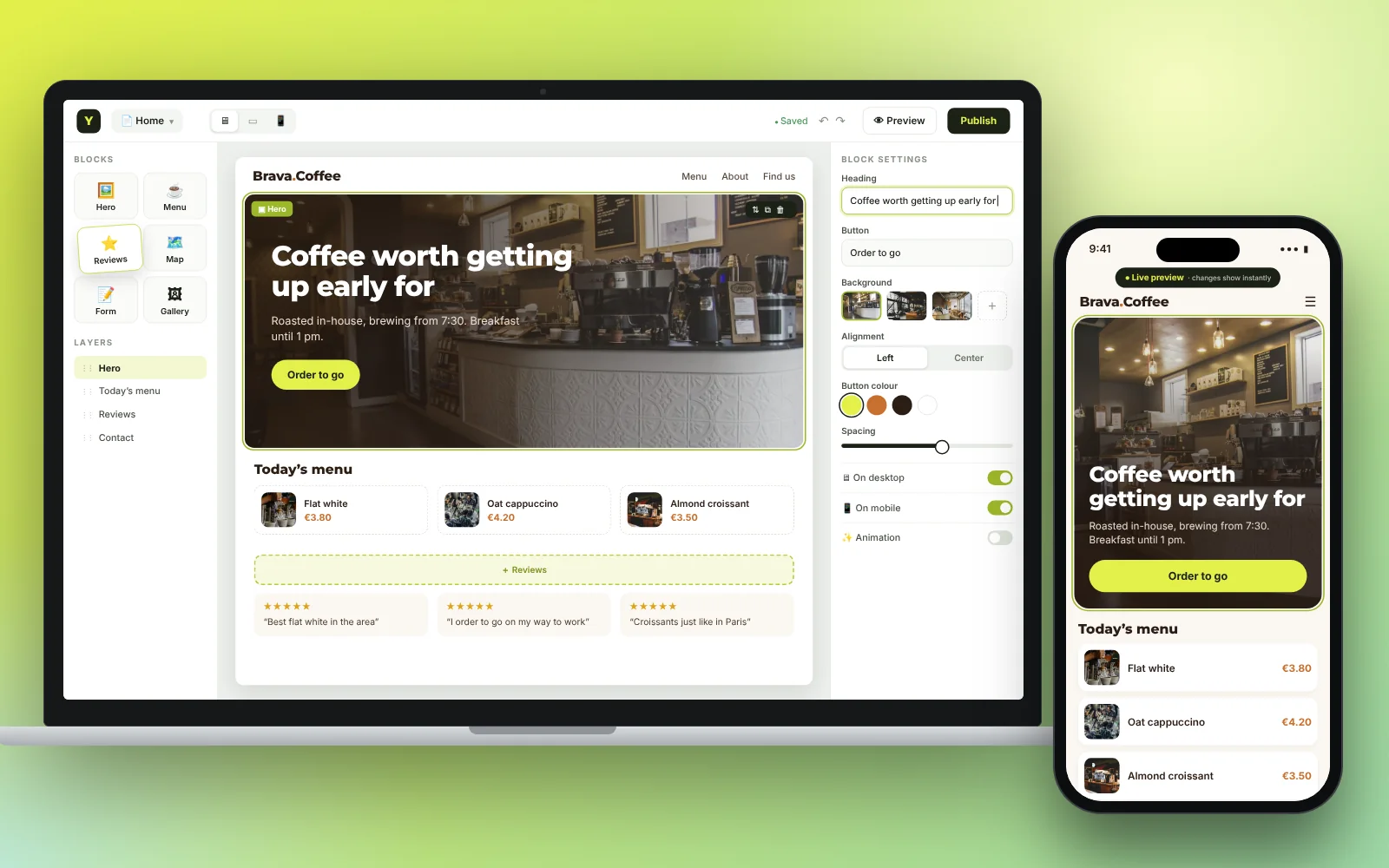
Website builder vs custom website: cost of ownership
Default values are benchmarks: platform subscriptions change, so check the plan on the platform's website. The YARDOS business website is €2,490 (price list v0.4). The domain is paid separately in both cases. Hosting of a custom site is €0 at the start; YARDOS maintenance is optional, from €49 a month.
Modules instead of a rebuild: how a site grows
The most common reason to switch from a builder to custom development sounds like this: "We have grown, and the platform does not give us what we need." You need subscription payments, a customer account, a CRM link, a second language, booking. Moving a site off a platform usually means building it again.
We build differently: modules are added to a working site instead of rebuilding it. First you launch a simple version. Then, when customers and revenue appear, the features you need are connected:
- online payments and delivery for a ready store, from €490;
- a client portal where the customer sees orders, documents and payments, from €2,490;
- a link to a CRM or accounting system, from €690 each;
- a new language for €290.
This way you do not pay up front for features you do not need yet, and you do not throw away what has been built when you grow. If the project outgrows an ordinary site and becomes a platform with roles, accounts and subscriptions, we start with a paid architecture session at €3,500, which is credited toward the project. How the path from a site to a SaaS looks is in "How to Build a SaaS".
When a website builder is really better
To make the decision easier, here are the cases where we ourselves recommend a builder:
- A personal project or hobby. A blog, a portfolio, a site for an event that is needed for a few months.
- Testing an idea over a weekend. You need to see whether people are interested before investing in development.
- A site you will edit every day yourself, when you have the time and the wish to do it.
- A very small budget. If you have under €500 and the money should go to inventory, not to a website.
And here are three signals that it is time to look at custom development:
- You pay more for builder add-ons than for the platform itself.
- Pages open slowly, and it is noticeable on a phone.
- Customers come from search and you keep hitting the limits of the settings.
If you need a site for a bank, a payment provider or a registrar, a builder is possible too, but reviewers look at the content: company details, contacts, a description of the business and legal pages. More on this in "What Website a Bank and Stripe Need".
How to avoid mistakes when choosing a contractor
If you have decided to order a site, the most important thing is to choose someone who will not lock you in. Check three things: whether the domain and accounts are registered to you, whether you receive the code and access at launch, and what the contract says about support. A detailed checklist is in "How to Choose a Web Development Company". And to compare offers with each other, write a brief using the template from "Website Requirements and Brief".
Also ask how the contractor sees growth. A good answer sounds like: "We will launch a simple version and add modules when you need them." A bad one: "Let us build everything now so we do not have to redo it later." The second option raises the price and the timeline, and half the features may never be used. If you are looking for a contractor in your country, prefer those who show real projects and name the price before work begins.
What to choose in your situation
- If you are testing an idea or building a personal project, take a builder. It is fast and inexpensive.
- If you offer a service in your country and customers come from search and ads, take a custom site, the business website at €2,490. SEO setup and speed pay for themselves in leads.
- If you need one page for ads, take a landing page at €790. The one-year price gap with a builder is small, while speed and ad setup are better. What a landing page is, read in "What Is a Landing Page and How a Selling One Works".
- If you are already on a builder and have hit its ceiling, do not abandon the site. We carry over the texts and page addresses and add what was missing. That is a redesign from €1,490.
- If you plan accounts, subscriptions and roles, a builder will not fit. Start with an architecture session.
- If you are not sure, write to us on the contact page: we will say honestly whether a builder is enough for you.
Frequently asked questions
Which is better: a website builder or custom development?
It depends on the task. A builder suits a personal project or testing an idea. For a business that needs customers from search, payments, accounts and integrations, a custom site pays off more. Compare the cost of ownership over three years, not the purchase price.
Is a custom website expensive?
Not always. With us a business card site costs €990 and a 10-page business website €2,490, because we assemble them from ready blocks. Market guides quote a couple of thousand dollars and up for agency development, but the price depends on scope and contractor.
Can I move a site from a builder to custom development?
Yes. Texts, photos and page addresses are kept, and the site itself is rebuilt. This is called a redesign, and with us it starts from €1,490.
Are website builders worse for Google search?
No, modern builders have improved their SEO settings a lot. Limits remain in fine tuning, speed and multilingual setup. If search is your main channel, a custom site is better.
What does "modules instead of a rebuild" mean?
We launch a simple site and later connect payments, a customer account, a CRM or a new language as separate modules. What has been built is not thrown away or rewritten.
Who owns a custom website?
You do. We register the domain, code and service accounts to you and work through invitations. If you decide to change contractors, the site stays yours.
Do you build on Wix, Squarespace or Webflow?
No, we build only custom sites. If a builder suits you, we will say so rather than sell something complex where something simple will do.
Sources
- How much does it cost to build a website? (Domain.com) · Domain.com
- Webflow Pricing 2026 · Capterra
- Webflow vs Wix vs Squarespace · iCoderz Solutions