What Is a Landing Page in Plain English
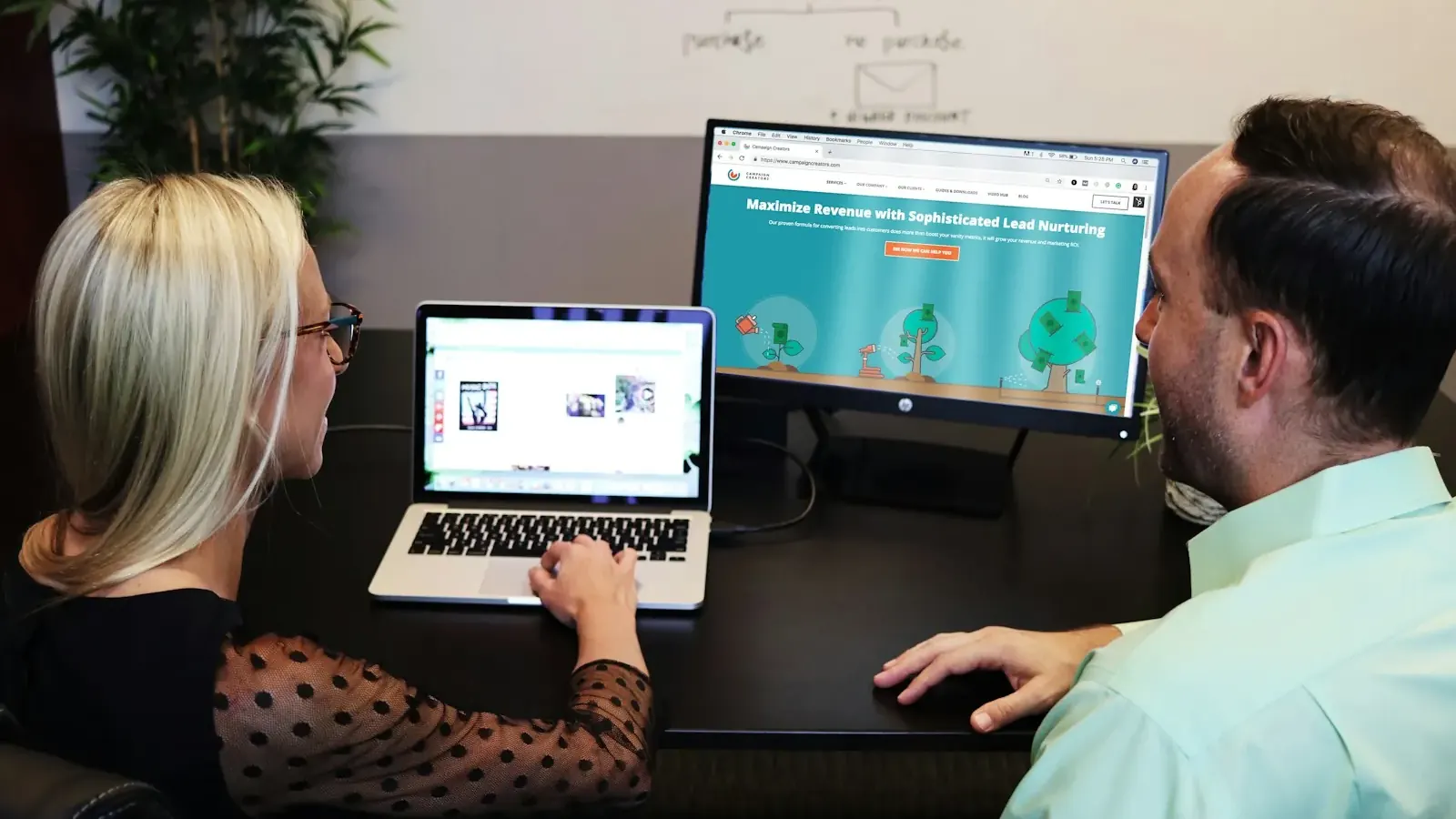
A landing page is the page a person “lands” on after clicking an ad, a link in a social post or a button in an email. Google Ads Help defines it the same way: the page someone reaches after clicking your ad.
A landing page always has one goal: leave a request, call, book or buy. That is why it has no extra sections, and every block leads to one button. Think of a salesperson who does not chat about the weather. They say what you get, what it costs and why you can trust them, and then ask you to place the order.
Where a landing page works best
- Paid ads. Someone clicked an ad about one specific service and should see exactly that, not your company’s home page.
- Product or event launches. One offer, one deadline, one form.
- Lead magnets. A visitor leaves an email and gets a checklist, an ebook or a consultation.
- Testing an idea fast. The page is cheap, and the requests show whether there is demand.
Landing Page vs Website: What’s the Difference
A regular website answers “who are you and what do you do?”. A landing page answers “why should I leave a request right now?”. Here is a side-by-side comparison.
| Landing page | Company website | |
|---|---|---|
| Pages | One | 5–30 or more |
| Goal | One action: a request, a call, a purchase | Tell the company’s story and answer many different questions |
| Menu | Usually none, or a minimal one, so nothing distracts | Yes, guiding visitors through sections |
| Where traffic comes from | Mostly ads, emails, social media | Search, direct visits, links |
| Google search | One page ranks for a limited set of queries | Many pages catch many queries |
| Price with us | €790 | €990 for a business card site, €2,490 for a business website |
| Timeline with us | 2–5 days | 3–14 days |
None of this means one is better than the other. A landing page will not replace a website if you want people to find you in search for dozens of queries. A website will not replace a landing page if you pay for ads, because every extra click on a menu takes a visitor away from the request form. Many companies use both. For more on choosing a format and a budget, see How Much Does a Website Cost in 2026 and How to Build a Business Website.
Landing Page Structure and Best Practices
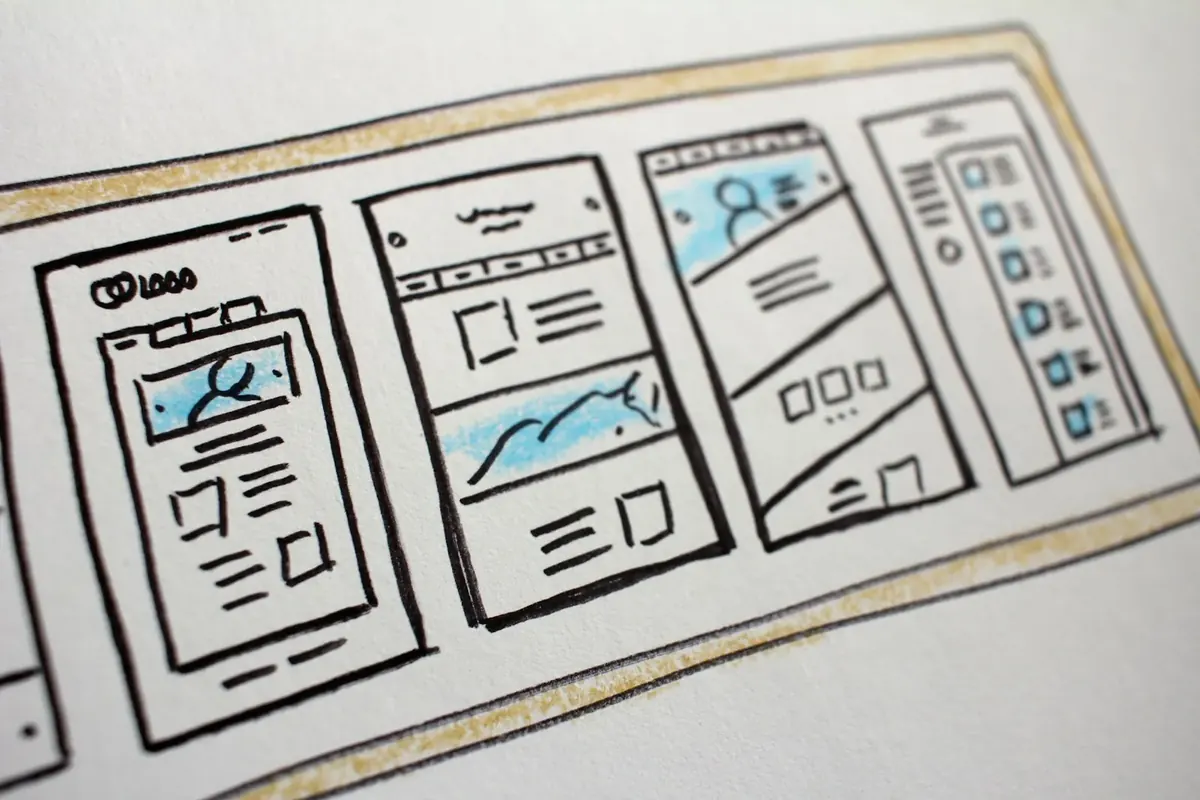
Structure is the order of blocks from top to bottom. We build a page from the blocks that answer a visitor’s questions in the order they naturally come up.
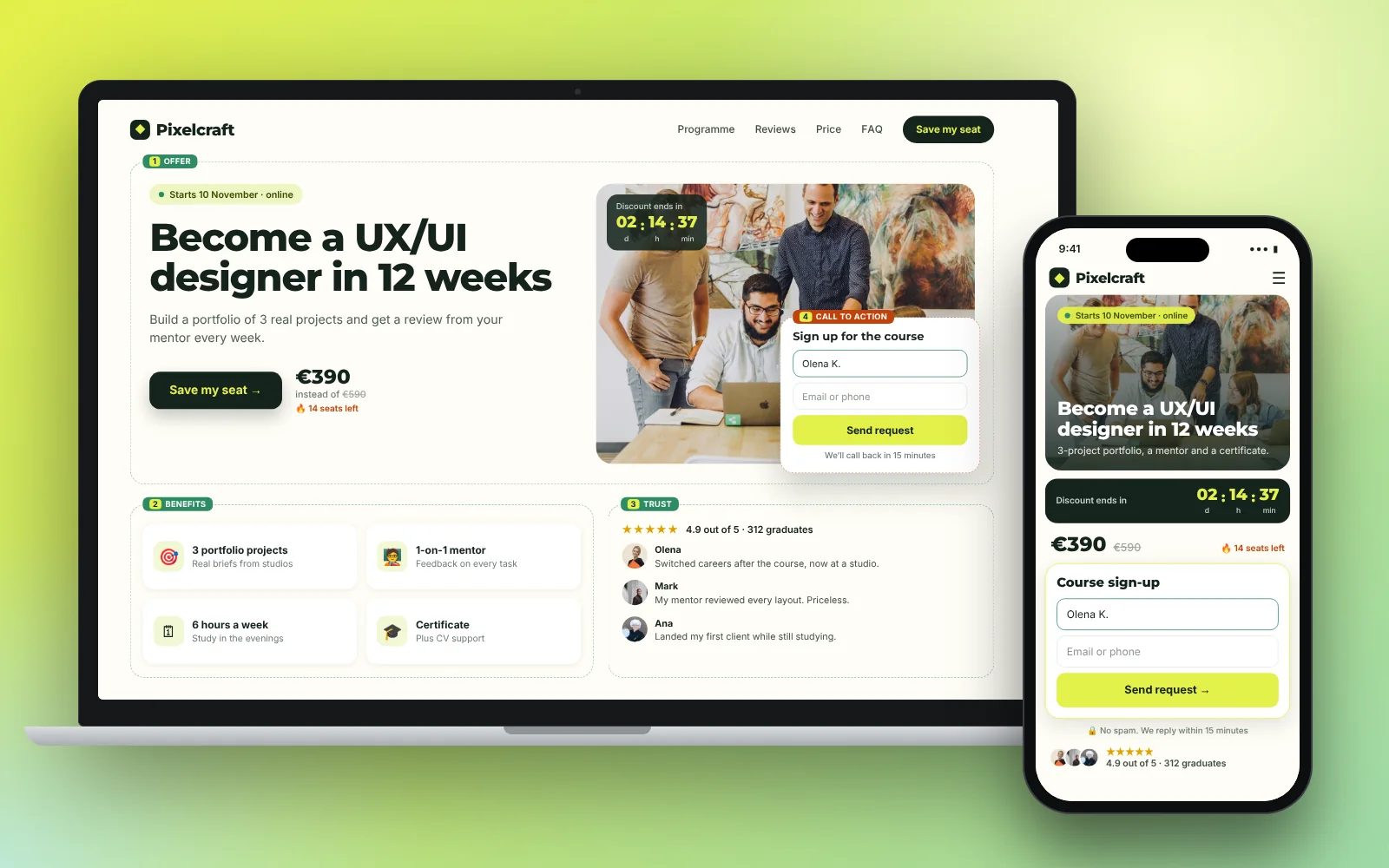
- Hero section (above the fold). A headline that says what you offer and to whom, a short subheading and one main button. This is the most important block: if people do not understand what you do, they leave.
- Problem and benefits. What the visitor gets. Not “we are the market leader”, but “a response within an hour” or “a website in 24 hours”.
- How it works. Three to five steps from request to result. It removes the fear of “what happens next?”.
- Proof. Real case studies, figures with a source, client logos, reviews. Only genuine ones, and with people’s consent. Invented testimonials do damage.
- Price, or “from” price. Hide the price and some visitors leave without asking.
- Objection handling (FAQ). “Is it expensive?”, “What if it doesn’t work?”, “How do I pay?”.
- Form and a repeated button. A short form: name and contact. The fewer the fields, the more submissions.
- Contacts and company details. For trust and for legal requirements: legal pages and a privacy policy.
We use this scheme as a base and adapt it to your niche. For local services in your country, local proof matters: the city, a map, reviews from customers in your area. For an online product, a demo and pricing matter more.
Landing page audit: what already works
- The hero headline says what you offer and to whom
- There is one main button and it is visible without scrolling
- The headline matches the promise in the ad or link
- Benefits are described as results for the customer, not features of the company
- There is real proof: case studies, reviews with names, figures with a source
- The price or a “from” price is stated
- There is an objection-handling block
- The form has fewer than five fields
- The page loads fast and works well on a phone
- Analytics goals and the ad pixel are connected
- Contacts, company details and legal pages are present
Which Landing Page Fits Your Business
The overall structure is the same, but the emphasis differs. Here is how we usually set it for each type of business.
Local service: repairs, clinic, salon, lawyer
People search nearby and want to understand the price quickly and trust you. We put the city, the phone number and a “Book now” button in the first screen. Below come reviews from real customers, photos of the work and a map. The form is short: name and phone.
Expert services and consulting
Here people buy the person. You need the expert’s face, experience, specific case studies and an honest description of who the service is not for. A booking form for a first consultation works well.
Online product: a course, a service, a subscription
The main job is to show what the product looks like and what the visitor gets. You need screenshots or video, plans, answers to objections and guarantees you really give. For a complicated choice, a quiz landing page helps.
B2B service
Several people make the decision, and they need facts: timelines, scope of work, case studies, a price or a range, how the work goes. It is better to frame the request as “request a proposal” rather than “buy now”.
If your niche is not on the list, that is fine: the brief will show which blocks you need, and we do not add anything extra.
How Much Does a Landing Page Cost
A landing page with us costs €790 and takes 2–5 days, provided the brief and materials are ready. The price includes the offer, structure, design built around your brief, responsive layout, a lead form, ad pixels (code that shows how many visitors came from ads and how many left a request) and legal page templates for your country. You pay for the domain separately (roughly €10–15 a year).
- Landing page: €790, 2–5 days.
- Quiz landing page: €890, 3–5 days. It is a landing page with a 5–7 question quiz: the visitor answers and leaves contact details, and you see what they need.
- A/B test and conversion growth: from €390, two versions of key blocks and measurement.
- Website in 24 hours: €599. One page, but a “business card” rather than a selling page, built to show your company to a bank or partner.
How is a landing page different from the “Website in 24 hours”? The latter is for verification and trust: a description of the business, contacts, legal pages. A landing page is for sales: offer, proof, objections, form. If you need both, start with whichever is more urgent.
The advertising budget is not included. To work out how much to spend, read How Much Does Google Ads Cost.
How We Build a Landing Page in 2–5 Days
The timeline does not depend on the amount of code. It depends on how fast we get your materials. This is the sequence we follow.
- Brief. You answer questions: what you sell, to whom, how you differ, the price, and where requests should go.
- Structure. We show a page outline made of blocks: what comes first, where the proof goes, where the form sits. This is the easiest stage at which to change the message.
- Design and build. A layout in your brand, responsive design, a request form and ad pixels.
- Testing. Mobile version, speed, a test request and the notification email.
- Launch. Connecting the domain, handing over access and a short guide to editing texts in the editor.
We register the domain, code and accounts in your name from the start. If after launch you want to grow the page into a full website, we add sections and a blog as modules rather than redoing everything. You can read more about the process on How we work. If you need the site to open quickly in any country, that is part of the default setup.
Why a Landing Page Brings Leads: What Matters for Ads
In Google Ads, landing page quality is part of a score that affects the price of a click. Google’s help center names these factors: useful and relevant content, easy navigation, and a match with what the person expected after seeing the ad. Put simply, the page should keep the promise made by the ad.
What this means in practice:
- The ad and the headline match. If the ad is about a “website in 24 hours”, the headline says the same.
- Fewer ways to leave the page. Every extra link takes the visitor away from the request.
- Speed. A page that takes longer than 2.5 seconds to load (the LCP metric, per Google’s guidance) loses people before they read the offer.
- Mobile version. A large share of ad clicks come from smartphones, so the button and the form must fit the screen.
Nobody can promise a specific conversion rate. Different studies give different averages, and they depend on the niche, the traffic source and the price. It is better to look at your own numbers and improve the page based on them, which is exactly what A/B tests and analytics goals are for.
Five Landing Page Mistakes That Kill Conversions
- A weak hero section. A headline like “Welcome” or “We are glad to see you” sells nothing.
- No proof. The page promises but confirms nothing. Add case studies, real reviews and specifics.
- A long form. Ten fields scare people off. Ask for a name and a contact, and clarify the rest in conversation.
- Too many buttons and goals. “Call”, “Download”, “Subscribe” and “Message us” on one screen split attention.
- One landing page for everything. If you have three services, you need three landing pages, or a quiz that sorts visitors by service.
A good way to find the weak spots is to run through the checklist in this article. It shows which blocks to strengthen first. And if you are choosing a contractor, check the article How to Choose a Web Agency and Avoid Mistakes.
What to Choose in Your Situation
- If you are launching ads for one service, get the €790 landing page. It takes 2–5 days and brings leads from exactly those ads.
- If the service is complex and the client has to pick an option, get the €890 quiz landing page: the quiz works out what the person needs.
- If you want to be found in Google for many queries, one landing page is not enough. You need a business website for €2,490 with a blog and pages for each service.
- If you only need a page for a bank or payment-provider check, look at the “Website in 24 hours” for €599, not a landing page.
- If you already have a landing page that does not bring leads, run it through the checklist and add an A/B test.
All prices and package contents are on the Pricing page. We work remotely, including with clients in your city: send us a brief and we will name an exact timeline.
Frequently asked questions
What is a landing page?
A landing page is a one-page website with one goal: for the visitor to leave a request, call, book or buy. It is used for ads, product launches and collecting contacts.
What is the difference between a landing page and a website?
A website tells the story of a company across several pages, while a landing page leads to one action on one page. A landing page is stronger for ads, a website for search and trust.
How much does a landing page cost?
With us a landing page costs €790 and takes 2–5 days, and a quiz landing page is €890. The domain is paid separately, roughly €10–15 a year. The advertising budget is not included.
Do I need a landing page if I already have a website?
If you pay for ads for a specific service, a landing page is usually more effective than the website’s home page. It has no extra sections, and the visitor sees the right offer straight away.
Will a landing page bring me customers from Google?
From ads, yes. From free search results it can rank for a limited number of queries, and nobody can guarantee positions. If you need a steady flow from search, you need a website with a blog and separate pages for each service.
Which blocks are essential on a landing page?
A hero section with the offer and a button, benefits, how it works, proof, a price or range, answers to objections, a form and contacts. The rest depends on the niche.
What is a quiz landing page?
It is a landing page with a short quiz of 5–7 questions. The visitor answers and leaves a contact, and you see what they need and can offer the right option.
Can I edit the landing page myself?
Yes. You change texts, photos and prices in the site editor. We change the structure and blocks on request.
Sources
- Landing page experience: Definition · Google Ads Help
- Landing page: Definition · Google Ads Help
- Core Web Vitals: how the metric thresholds were defined · web.dev (Google)
- Landing pages vs homepages · Landingi