
What Determines the Price of SEO
SEO (search engine optimization) is the work of making your site appear in Google more often for your customers’ queries. The price depends not on “magic” but on the amount of work: how many queries you want to cover, how many pages and articles need to be prepared, how technically healthy the site is and how strong the competitors are.
SEO is almost always paid monthly. In an Ahrefs survey of 439 SEO professionals, the most common monthly retainer range was $501–1,000 a month. Averages are higher: in the survey they come to about $2,900 a month, higher at agencies and noticeably lower for freelancers. This is worldwide data, and in your country and in your niche the figures will differ, so take them as a benchmark, not a price list. Note that the survey figures are in US dollars, while our prices below are in euros.
Our packages and timelines
Our prices are published in full, without an “individual quote” as the first step (YARDOS price list v0.4, in euros):
| Package | Price | Minimum term | What is included |
|---|---|---|---|
| Start | €490 a month | 3 months | Up to 20 queries, technical audit and fixes, Search Console setup, a monthly report |
| Growth | €790 a month | 3 months | Everything in Start, up to 50 queries, 2 articles a month, basic external links, a report on leads from search |
| Leader | €1,490 a month | 6 months | Everything in Growth, up to 100 queries, 4 articles a month, AI search visibility, a monthly meeting |
You can also take a separate SEO audit for €490: a one-off review of errors, structure and competitors with a work plan. It stays with you even if you promote the site yourself or with another agency.
What is not included in the price
You pay for the domain, hosting and third-party services directly, and we add no markup on infrastructure. Translations into other languages or promotion in several countries at once are a separate service, “International SEO”, from €990 a month.
What SEO Services Include
Good SEO has four parts, and it is worth comparing prices by them rather than by the general word “promotion”:
- Technical order. The site has to load fast, display properly on a phone and be available for indexing (that is how pages get into a search engine’s database).
- Pages for queries. Each important customer query needs its own page with a clear answer. This is the foundation: without it nothing else works.
- Articles. They cover questions like “how to choose”, “how much does it cost” and “which is better”, and bring in people who have not yet decided to buy.
- External links and mentions. These are publications about you on other sites. They build trust, but buying links in bulk on dubious sites is risky.
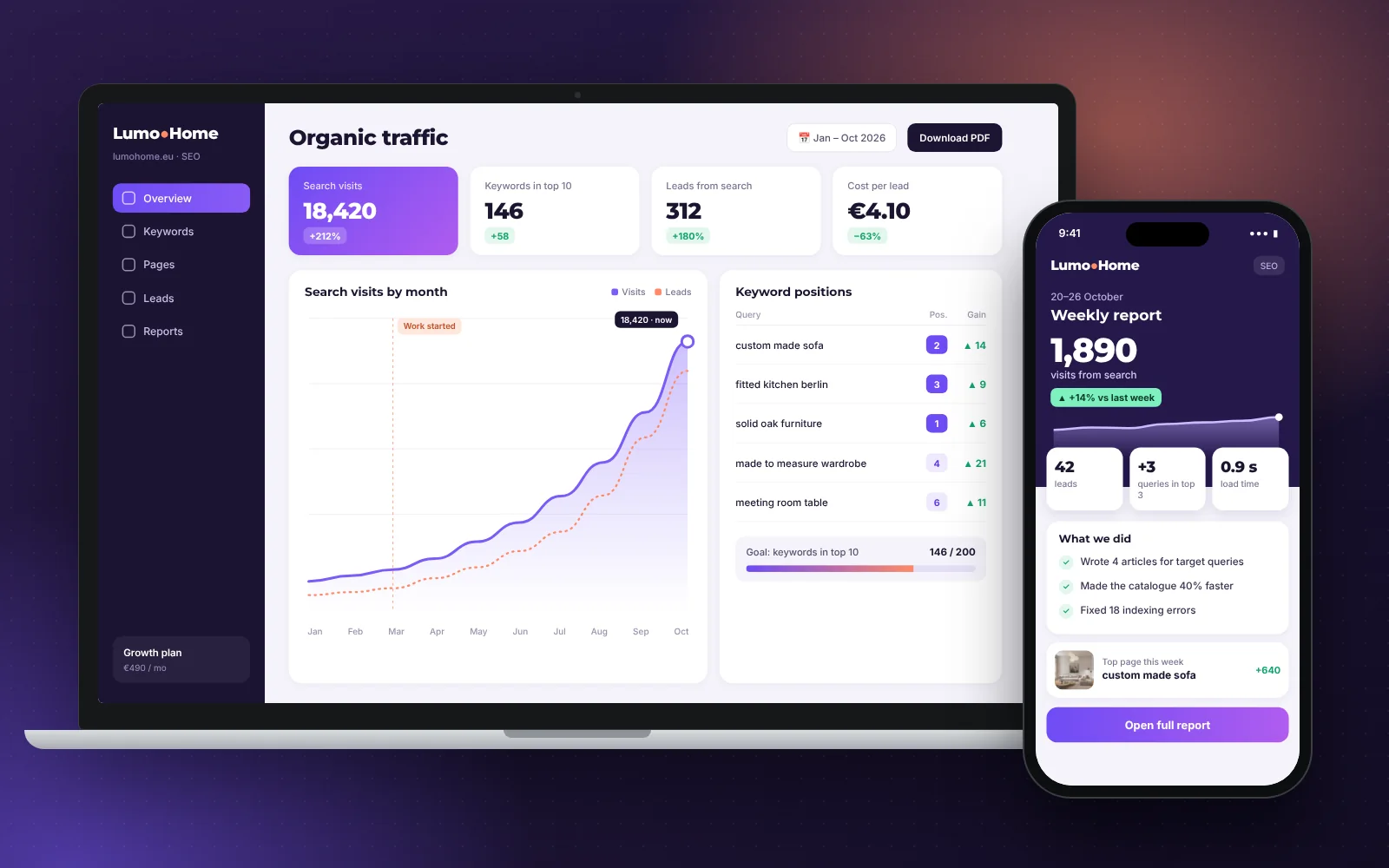
Every month you should receive a report: which queries are growing, how many visitors arrive and how many of them leave a request. If the report only has “keyword positions” and no leads, you are not seeing the main thing.

How Long Does SEO Take: When to Expect Results
The short, honest answer: months, not weeks. Ads give you clicks on the day they launch, while SEO builds traffic that stays and gets cheaper over time, but it takes time. In our experience, the first movement shows after 2–3 months and steady growth after 4–6 months, if the recommendations on the site are carried out. That is why our minimum term is three months: in less time you cannot judge the result honestly.
What the speed depends on
- Age and condition of the site. A new site needs time for Google to notice it and start trusting it. For a site with technical errors, time goes into fixing them.
- Competition. In a niche with a hundred strong sites, growth is slower than in a narrow local one.
- The query. Narrow queries like “how much does a website for a coffee shop cost in your city” deliver faster than general ones like “web design”.
- How fast fixes are made on your side. If recommendations sit unimplemented for months, no contractor will deliver results.
What Google says
In its official guide “Do you need an SEO?”, Google states plainly that nobody can guarantee the first place in search results, and promises of a “special relationship” with Google or paid “priority submission” are a reason to be wary. The decision on what to show is made by the search engine. That is why we promise a plan of work and a transparent report, but not positions.
What to expect month by month
The first month goes to technical order and preparing pages, and there is no noticeable traffic yet. In months two and three, Google starts indexing the new pages and showing them for the first queries. From the fourth to the sixth month it is usually clear which pages are growing and which need to be rewritten. If there is no movement at all after three months, it is a signal to look into the causes rather than simply keep paying.
Will SEO pay off: traffic and lead forecast
This is an illustration, not a forecast: you set the growth, while search rankings are determined by the search engine. The default values are a hypothetical example (the Growth package, €790 a month); enter your own figures from your analytics.
How to Work Out Whether SEO Will Pay Off
The calculator above is built on a simple chain: visitors, leads, sales, revenue. You enter your current traffic, the expected monthly growth, the share of visitors who leave a request, the share of requests that turn into a sale, the average order value and the SEO budget. The output shows how many leads and how much revenue arrive each month and when the spend pays back.
Two important warnings. First, this is an illustration, not a forecast: you enter the growth percentage yourself, and in reality it depends on how the search engine behaves. Second, SEO almost always pays off not in the first months but later, because at the start you are paying for the foundation. If you need leads this week, start with ads: details are in the article on how much Google Ads costs.
One more check: your average order value and your close rate. If one customer brings in €1,200 and SEO brings in even a few such customers over a year, spending €790 a month may be justified. If the order value is €30 and sales go through a marketplace, consider whether you need a site in search at all.
SEO Checklist for a New Website
If the site is new, start not with a retainer but with the basic setup. You can do it yourself or have a contractor check it, and it requires no monthly spend:
- Connect Google Search Console and submit a sitemap. This is the most direct way to tell Google which pages your site has.
- Check that the site is not blocked from indexing: a wrong setting in robots.txt or a noindex tag is a common reason for an “invisible” site.
- Every page should have its own title, a description and one main H1 heading with a clear query.
- Check responsive design: the site must look good and work on a phone.
- Measure load speed and remove what is not needed: heavy images, unnecessary scripts.
- Use clear page URLs in Latin letters, without random characters.
- Link pages to each other: from articles to services and back.
- Add contacts, company details and legal pages: they raise trust with both people and search engines.
- Connect analytics to see where people come from and what they do.
- Publish the first pages for real customer queries, not general words about the company.
These points match the basic recommendations in Google’s SEO Starter Guide. If the site has not been created yet, we do all this during the build: see how much a website costs and the business website with SEO for 20 queries.
Which Keywords to Start With
The main mistake beginners make is chasing the most popular query. Millions of people search for the word “website”, but most of them buy nothing, and competition there is at its maximum. Start with queries a person types right before ordering: “how much does … cost”, “hire …”, “price of …”, “reviews of …”. They are searched less often, but each such visitor is closer to buying.
Split queries into three groups: commercial (service and price), comparison (“which is better”, “what is the difference”) and informational (“how to”, “what is”). The first need service pages, the second and third need articles. Our blog is built the same way: each article answers a question the person has before a decision and leads to a suitable service. If you do not know where to start, we will show it in an audit.
How Not to Overpay and Spot Honest SEO
The SEO market is noisy, so it helps to know the red flags:
- A guarantee of the top spot, or “first place in a month”. Google’s own guide calls such promises a warning sign.
- Secret methods. A contractor should explain what exactly they do on your site and why.
- A price without a scope. “SEO for €100” with no number of queries, articles or a report is not a service, just a name.
- Your site and access are registered to the contractor. Search Console and analytics accounts must belong to you.
- Bulk link buying. Cheap links from junk sites can hurt rather than help.
The principle for choosing an SEO contractor is the same as for website development: ask for the scope, a sample report and client contacts, and ask who owns the access. We covered a detailed checklist in how to choose a web agency and avoid mistakes.
SEO, Ads and AI Search: What to Choose First
The three channels solve different tasks. Ads give clicks immediately, for as long as you pay. SEO builds permanent traffic but takes months. AI search visibility (GEO, generative engine optimization) helps you get into the answers of ChatGPT, Gemini and Perplexity, and relies on the same foundation: clear pages and trust in the source. We explained how it works in how to get into ChatGPT answers.
The practical order for most small businesses is this: first a site with a solid technical base, then pages for queries, then articles and links, with AI visibility added on top. Ads come in where you need leads before SEO starts to work.
What to Choose in Your Situation
- You do not have a site yet. Site first, and the SEO foundation is laid during the build. Start a retainer when service pages appear.
- The site is new and the budget is limited. Go through the checklist above yourself or order an SEO audit for €490 and implement the recommendations at your own pace.
- You have a site but no leads from search. The Start package at €490 a month: order on the site and the first queries. Commit to at least three months.
- You need steady growth. The Growth package at €790 a month: articles and links create momentum. Details are on the monthly SEO page.
- Customers search for you in your own city. Add local SEO (maps, reviews, customer queries in your city) from €290 a month.
- You work in several countries. You need separate keyword research for each market: “International SEO” from €990 a month.
- You need leads right now. Start with ads and launch SEO in parallel as a long-term asset.
You can see the cost of all services on the Pricing page.
Frequently asked questions
How much does SEO cost per month?
Our packages cost €490, €790 and €1,490 a month. The difference is the number of queries, articles and links. In Ahrefs’ worldwide survey, the most common range among specialists is $501–1,000 a month, and the average is noticeably higher.
How long does SEO take?
First movement is usually visible after 2–3 months and steady growth after 4–6, if the recommendations are implemented. Exact timelines depend on competition, the age of the site and the state of its pages, so we do not promise them.
Can anyone guarantee the number one spot on Google?
No. Google’s own guide says plainly that nobody can guarantee first place. An honest contractor promises a work plan, a report and an explanation of the changes, not positions.
Can I do SEO myself?
Yes, the basics on the checklist are within reach of a site owner: Search Console, titles, speed, a sitemap. You need a contractor when you lack time or experience, or want systematic growth in a competitive niche.
How is SEO different from advertising?
Ads bring clicks for as long as you pay. SEO delivers traffic that remains after the work is paid for and gets cheaper over time, but results come after months. Many businesses use both channels.
What is an SEO audit and do I need one?
It is a one-off review of the site: errors, structure, competitors and a work plan. It costs €490 and suits you if you want to understand the situation before signing up for a retainer or to implement the recommendations yourself.
Can I stop SEO once results appear?
You can, but the effect gradually weakens: competitors do not stand still and content ages. Often, after reaching the desired level, people switch to a lighter maintenance package.
Who owns the access and the reports?
You do. Search Console, analytics and the site are registered to you, and we work by invitation. If you decide to leave, all history and data stay with you.
Sources
- Do you need an SEO? · Google Search Central
- SEO Starter Guide · Google Search Central
- SEO Pricing: How Much Does SEO Cost? 439 People Polled · Ahrefs