
What Is Generative Engine Optimization (GEO)?
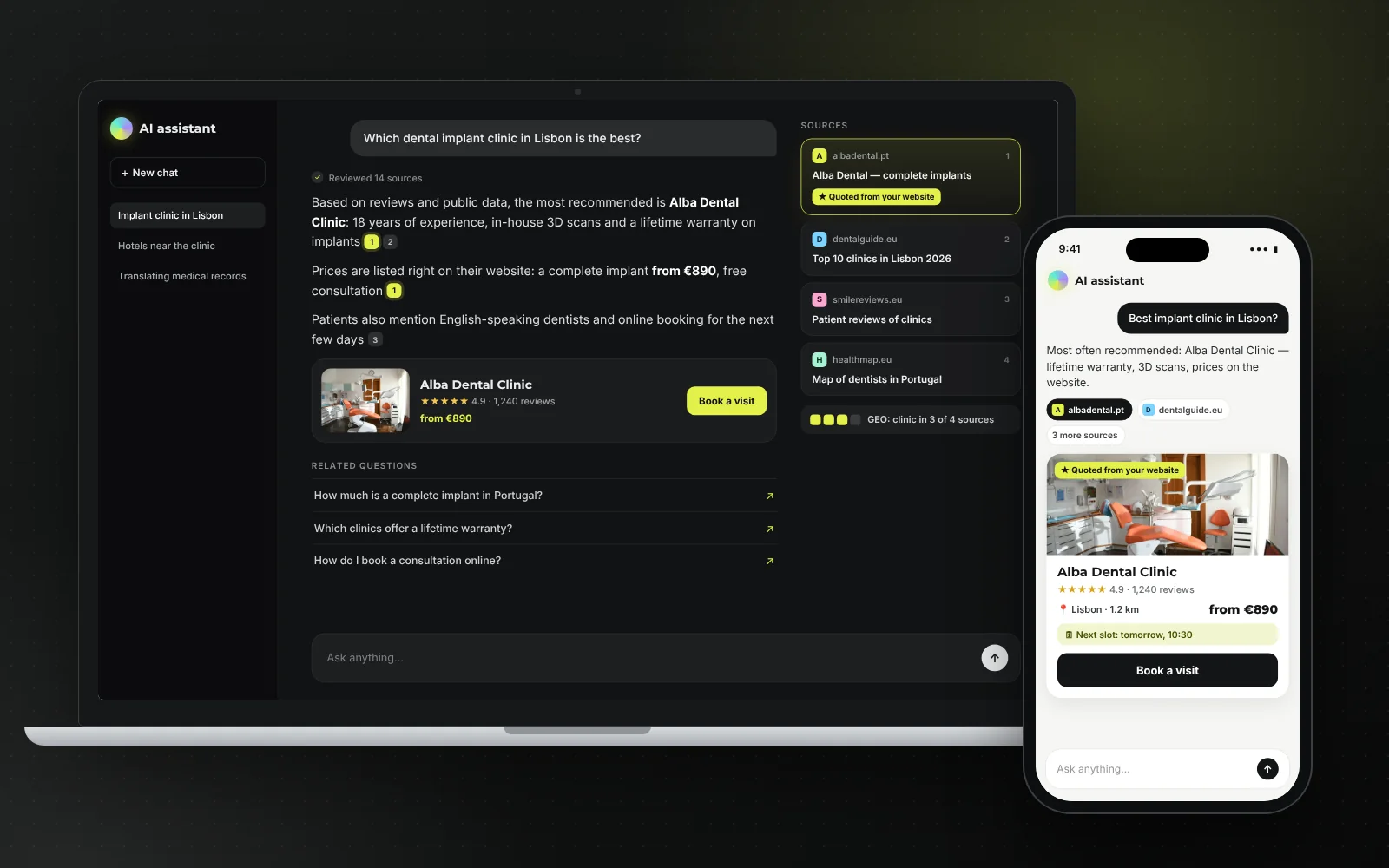
People used to type a query into Google and get a list of links. Now they increasingly ask ChatGPT, Gemini or Perplexity a question and get a ready-made answer. The work of getting such systems to find your site and mention your company in the answer is called GEO: generative engine optimization.
The term was established by the research paper “GEO: Generative Engine Optimization” (Aggarwal et al., arXiv 2023, accepted to KDD 2024). The authors assembled a set of 10,000 queries and tested which changes to a text raise a source’s visibility in AI answers. We go through the results below.
It is important to understand the limits right away. An AI model does not “rank” sites by a clear formula: the answer is assembled on the fly from the pages it finds and what the model remembered during training, and it can differ from one request to the next. So honest GEO is not a “guaranteed placement” but a set of actions that raise the probability that you will be found and cited.
GEO vs SEO: What’s the Difference
SEO helps a site appear in the list of search results. GEO helps it get into the answer that an AI model writes itself. They share a foundation: clear pages, access for crawlers and trust in the source. That is why GEO works better on a site where SEO is already in order, and it does not replace SEO. It is the next step, not a way to give up on search. How ordinary promotion works and what it costs is covered in how much SEO costs.
How the result differs
- In SEO you fight for a place in a list, and the result can be measured as a position.
- In GEO you fight for a mention or a link inside an answer, and the result is unstable: the same question can produce different answers.
- In SEO the person more often clicks through to the site. In an AI answer they may get the solution without opening any page, so it matters that your brand and key facts are stated right in the answer.
AEO vs GEO: are they the same thing?
AEO (answer engine optimization) is optimization for systems that give a direct answer to a question: answer boxes in search, voice assistants. GEO is for generative AI models. The difference is subtle and the techniques overlap: short, precise answers, structured data and trust in the source. For a small business there is no need to separate them. It is enough to build a site that answers questions clearly.

How AI Models Choose Whom to Mention
A ChatGPT answer can be built in two ways. The first is from what the model “remembered” in training: knowledge up to a certain date, which cannot be changed quickly. The second is from fresh search: when search is on, the system looks for pages on the internet, reads them and retells them with sources. The second path is the one open to a small business, because you can work on it today.
For search, ChatGPT has its own crawler, OAI-SearchBot. According to OpenAI’s documentation, it is responsible for showing sites in ChatGPT’s search features and is separate from GPTBot, which collects data for training models. If your site is blocked for OAI-SearchBot in robots.txt, it will not be shown in such answers (except as a link when a person searches for it by name).
Google has its own features: AI Overviews and AI Mode. In its guide for site owners, Google explains that no special technical tricks are needed to appear in these features: the page has to be indexed and eligible to show in regular search. So healthy SEO already covers half of the task.
What Actually Improves Your Chances: Research Findings
In this paper (authors from Princeton and other universities), several text-editing techniques were tested. The authors report that the best methods raised a source’s visibility in AI answers by about 40% compared with the original text, and in a real-world test on Perplexity the improvement reached 37%. Since “up to 40%” is a ceiling under a suitable method and query, not a typical result, do not expect miracles from GEO.
What worked best: adding links to sources, quotations from reliable sources and concrete statistics. In other words, texts with verifiable facts are cited more readily than text stuffed with keywords. Empty repetition of queries (“keyword stuffing”) did not have this effect. The authors also note that the effectiveness of techniques depends on the topic, so one template does not work for every case.
The practical conclusion is simple: do not write “for the AI”, write for a person who wants an accurate answer, and back your words with facts.
Three myths about GEO
- “You can pay and be guaranteed a place in the answer.” You cannot. You cannot buy a citation inside an answer: ads in AI services, where they exist, are shown separately and labeled. And anyone who promises a guarantee is promising something they do not control.
- “AI models need special texts.” No. They need clear texts with facts: what is useful to a person is useful to the model.
- “SEO is no longer needed.” It is. AI search features rely on the same page index and the same trust signals, so without an SEO foundation AI search often simply does not find the site. For companies in your country this is especially noticeable if competitors already hold the usual queries.
The Technical Minimum: Making Sure You Can Be Found at All
Before thinking about content, check the foundation. If a crawler cannot read the site, nothing else matters:
- Indexing. Pages are open to Google and connected to Search Console.
- The robots.txt file. It does not block OAI-SearchBot or other search crawlers you want to let in. Whether to block training crawlers is a separate decision for the site owner.
- Text in HTML. Important facts must be in the page text, not only in images, PDFs or pop-ups.
- Speed and mobile version. A slow site is read worse by both people and crawlers.
- Structured data. Schema.org markup for the organization, services, prices and questions and answers helps a machine understand what exactly is written on the page.
- Company details and contacts. Company name, address, legal pages: this is how a system learns there is a real business behind the source.
Test yourself in the calculator below: it estimates your site’s readiness for AI search and suggests first steps.
Markup is not magic: it will not make an AI model cite you, it only helps it unambiguously understand where the price is, where the question is and where the company name is. So add it after the texts themselves are clear.
Is your website ready for AI search?
- The site is connected to Google Search Console and the pages are indexed
- robots.txt does not block the search crawlers you want to let in (including OAI-SearchBot)
- Important facts (prices, timelines, scope of services) are written as text on the page, not only in images or PDFs
- Service pages begin with a short, direct answer to the customer’s main question
- Pages have a “Questions and answers” section with real customer questions
- Structured Schema.org markup is added (organization, services, questions and answers)
- The site loads fast and works well on a phone
- The company name, details, contacts and legal pages are shown
- Texts include links to sources and verifiable figures, not only general words
- There is an update date, and prices and terms are current
- The company is mentioned outside your own site: directories, profiles, articles
- You have checked at least once what ChatGPT, Gemini and Perplexity answer to your customers’ questions
Content That Gets Cited
An AI model takes from a page a piece that can be retold. So your page should contain such pieces:
- A direct answer at the start. For “how much does it cost”, a figure in the first two sentences, then the details.
- Concrete facts. Prices, timelines, scope, terms. “Cheap and fast” cannot be quoted, but “€599 and 24 hours from receiving the materials” can.
- Sources. Links to documentation, studies and official pages back you up and raise trust.
- Questions and answers. An FAQ section with real customer questions mirrors the form of a query to an AI.
- An author and a company. It is clear who wrote it and who stands behind the words.
- Freshness. An update date and current figures. An outdated price kills trust.
This is how we write ourselves: an answer in the “In short” block, price tables, an FAQ and a list of sources in every blog article. If you need your pages to look like this right now, SEO articles from €150 per article will help.
External Mentions and How to Check the Result
AI models trust not only your site but also what others write about you: industry directories, articles, profiles on authoritative platforms, reviews, mentions in professional communities. If there is not a word about the company anywhere except its own site, it is hard for the system to verify that it exists. An identical name, description and contacts across all platforms help the model link them into one company.
How to check whether AI sees you
Make a list of 15–20 questions a customer would ask before buying: “who builds websites in your country on a small budget”, “how much does a landing page cost”, “how to choose a web agency”. Once a month, ask them in ChatGPT, Gemini and Perplexity and record whether you are mentioned, who is mentioned instead of you and which sources are cited. Answers fluctuate, so look at the trend over several checks, not at a single result. This is the kind of report we show our GEO clients.
A plan for the first week
- Check robots.txt and page indexing in Search Console.
- Rewrite the beginning of your three main service pages: a direct answer, price, timeline, what is included.
- Add a “Questions and answers” block to each page, built from real customer questions.
- Align the company name, description and contacts in profiles and directories in your city and in your industry.
- Save the list of control questions and run the first check of AI answers: this is your starting point.
How Much Does GEO Cost
With us, AI search visibility (GEO) is an add-on to SEO from €490 a month. In the Leader package at €1,490 a month it is included at no extra charge. We do not sell GEO separately from a site with a solid SEO foundation, because without it there will be no result: pages first, mentions second.
What you get: a check of the site’s accessibility for crawlers, a rebuild of key pages for short, precise answers, markup, a plan for external mentions and a monthly report with checks of AI answers. What we do not promise: getting into answers, a place in them, or traffic growth by a certain date. If a contractor guarantees “top spot in ChatGPT”, that is a reason to be wary. We described how to vet any contractor in how to choose a web agency and avoid mistakes: the principle is the same.
What to Choose in Your Situation
- You do not have a site yet. Start with a site with a good structure. Texts in the form of short answers and an FAQ are built in during the build, see the business website.
- You have a site, but it is “quiet”. Go through the checklist, fix robots.txt and markup, and add an FAQ and prices to the text. You can do this without a retainer.
- SEO is not set up. Start with an SEO audit for €490 or a monthly SEO package: GEO without this foundation is weak.
- You have the foundation and need AI mentions. Add GEO from €490 a month on top and watch the trend in answers over 3 months.
- You need leads right now. AI search is not a fast channel. For quick leads, use advertising.
- You work in several countries. Answer customers’ questions in their language: an AI model picks sources to match the language of the question.
You can find the prices of all services on the Pricing page.
Frequently asked questions
How do I get into ChatGPT answers?
You need a site that is open to search crawlers, with clear answers to customer questions, facts and sources, plus mentions of the company on other platforms. A placement cannot be guaranteed: AI answers depend on many factors.
How is GEO different from SEO?
SEO helps a site appear in the list of search results, while GEO helps it get into the answer an AI model writes itself. The foundation is shared, so GEO works better on a site where SEO is in order.
What is AEO and how is it different from GEO?
AEO is optimization for systems that give a direct answer to a question, and GEO is for generative AI models. In practice the techniques overlap: short, precise answers, markup and trust in the source.
Do I need to let OAI-SearchBot crawl my site?
If you want to appear in ChatGPT’s search features, yes. According to OpenAI’s documentation, OAI-SearchBot is responsible for showing sites in ChatGPT search, while GPTBot collects data for training. The decisions on each are made separately.
How do I get into Google’s AI Overviews?
Make pages that answer the question briefly and precisely, check indexing and add structured data. According to Google’s guide, no special technical tricks are required for these features, but Google makes the decision on what to show.
How do I know whether an AI model mentions me?
Make a list of the questions your customers ask and check the answers in ChatGPT, Gemini and Perplexity once a month. Record whether you are mentioned and which sources are cited. Look at the trend, not a single answer.
How much does GEO cost?
With us it is from €490 a month as an add-on to SEO, and in the Leader package at €1,490 a month AI search visibility is included at no extra charge. We do not guarantee mentions, but we show the checks and the changes.
Do I need GEO if my site is only launching?
First you need the site itself and basic SEO. If you are starting out, order the “Website in 24 hours” or an audit, and add GEO once you have service pages and first materials.
Sources
- GEO: Generative Engine Optimization (Aggarwal et al.) · arXiv / KDD 2024
- AI features and your website · Google Search Central
- Overview of OpenAI Crawlers · OpenAI
- SEO Starter Guide · Google Search Central