
How to Choose a Country for Your Company: Five Questions
There is no universally “best” country. There is the country that fits your task. Ask yourself five questions.
- Where are your customers and partners? If you sell to Germany, a German GmbH inspires more trust. If you serve customers worldwide online, a convenient jurisdiction is enough.
- Where does the owner live and manage the business from? Taxes depend on it. A company in one country does not cancel tax obligations in your country of residence, for example in your country. US and UK residents in particular should ask a tax adviser about extra reporting for foreign companies. This is the main topic for a tax consultant.
- How much money can you lock up in capital? From €1 to €25,000 and more, depending on the form.
- Do you need a notary and a personal visit? In some places registration is fully online, in others you need a notary.
- Which bank or payment provider do you need? An electronic money wallet (EMI) is one thing, a bank in the country of registration is another. Whether an organization agrees to serve you depends on your line of business.
Now an important limitation. Registering a company does not guarantee that you will get an account. Banks and payment providers check the business, the owners and the line of business, and they are entitled to refuse. We promise neither registration timelines, nor bank decisions, nor decisions of government bodies. A partner law firm handles registration, and we build the website that the check requires. For more on the site, see what website a bank and Stripe require.
Estonia and e-Residency: How to Set Up an OÜ
Estonia is popular with online entrepreneurs because registration can be done remotely. It helps to separate two things. e-Residency is a digital identity issued by the state: a card you use to sign documents electronically. It is not citizenship or a residence permit. OÜ (osaühing) is the Estonian private limited company itself.
What the official data says
- The state fee for registering an OÜ is €265 (the e-Residency page on the cost of starting a business).
- The minimum share capital of an OÜ is €0.01 per shareholder (e-Residency Learning Center; since 1 February 2023). If the capital is below €2,500, shareholders are liable for the company’s debts up to the amount missing to €2,500, so confirm the terms with a registrar or provider.
- The e-Residency card: a state fee of €150 on application and renewal from 2025, with a single rate of €165 planned from 1 January 2027 (e-Residency blog).
What is usually added on top
Provider services: a legal address in Estonia, accounting, a representative. These are commercial prices that vary a lot, so we do not state them as fact. Request offers from several providers. Also check the address and contact-person requirements with an Estonian provider.
Who it suits
IT, consulting, digital services and online trade, when the owner is not in Estonia. But remember: as with any jurisdiction, taxes depend on where you live and manage the business, and banks look closely at the company’s ties to the country. e-Residency does not promise that an account will be opened, and a website and a description of the business are still necessary.

How to Set Up a GmbH in Germany: Costs and Capital
A GmbH (Gesellschaft mit beschränkter Haftung) is a German limited liability company and the most recognizable business form in Germany. Having a GmbH builds trust with partners and banks, but it costs more and is more complicated to set up.
Capital and formalities
- The minimum share capital of a GmbH is €25,000. For a cash contribution, at least €12,500 must be paid in before filing with the commercial register (§ 7 GmbHG).
- The articles of association must be notarized, registration goes through the commercial register (Handelsregister) at the local court, and a business registration (Gewerbeanmeldung) is also needed.
- Notary, court and filing costs, not counting the capital itself, are estimated in public sources at anywhere from a few hundred to a couple of thousand euros. The exact amount depends on the capital and the articles.
UG (haftungsbeschränkt): the “mini GmbH”
For a small start in Germany there is the UG (haftungsbeschränkt) with capital from €1. The name must include the label “UG (haftungsbeschränkt)”, and the company must set aside part of its profit as a reserve (a quarter of the annual profit under § 5a GmbHG) until its capital reaches the GmbH level. It is cheaper to start, but banks and partners look at this form more cautiously.
A GmbH for foreigners
A foreigner can be a founder and a managing director, but in practice the following matter: an address in Germany, a German bank account for paying in the capital, documents in German and tax status. A German notary and a tax adviser resolve these questions. A website for a German company must have an Imprint (more below).
Poland and Cyprus: sp. z o.o. and a Private Company
Poland: sp. z o.o.
The sp. z o.o. (spółka z ograniczoną odpowiedzialnością) is the main form for small and medium-sized businesses in Poland. The minimum share capital is 5,000 zloty (PLN). The agreement can be signed online through the S24 system using a standard template. According to Polish accounting services, the court fee is 250 PLN plus 100 PLN for publication in the Monitor Sądowy i Gospodarczy (about 350 PLN in total). Registering through a notary costs more, so check the official Ministry of Justice pages. A tax on civil law transactions (PCC) of 0.5% on the capital is also paid.
Poland is a good fit if you work in the Polish market: a nearby region and clear forms, but the tax rules for foreign owners need to be studied separately.
Cyprus: a private limited company
In Cyprus a private company has no mandatory minimum capital, and in practice about €1,000 of authorized capital is often used. Registry fees depend on the authorized capital: according to public guides, with authorized capital up to €5,000 it is about €105, plus stamp duty on the capital. Figures differ between sources, so get the current tariff from a lawyer or the registry. You need at least one director, one secretary and a registered address in Cyprus. The indicative registration time, according to a law firm, is about 8–10 days.
Cyprus is chosen for its tax regime and work with international clients, but banks’ requirements for “substance” (real ties to the country) have grown in recent years. Plan a consultation with a Cypriot lawyer.
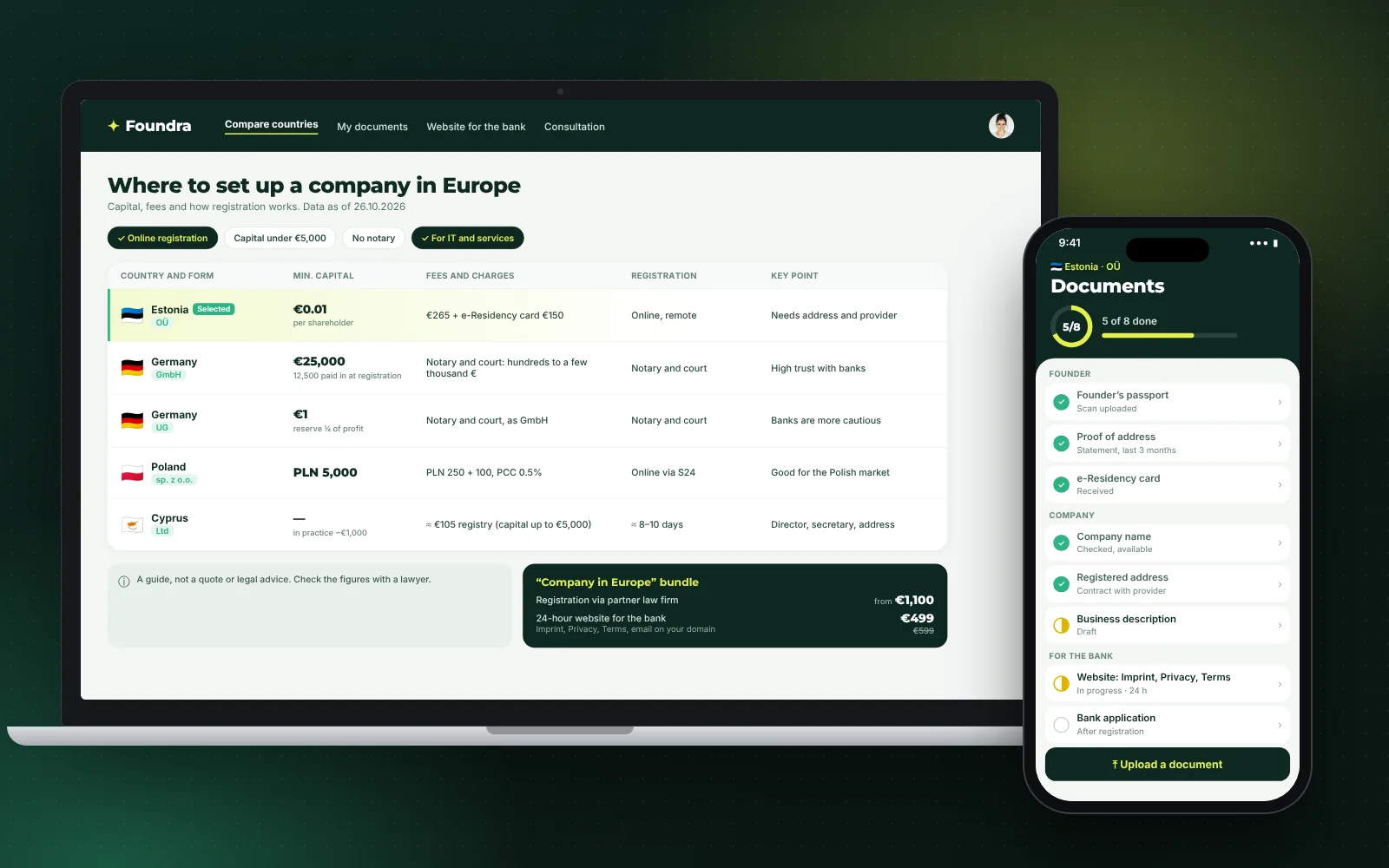
EU Company Formation: Country Comparison and First-Year Costs
The table below collects benchmarks from public sources as of 26 Oct 2026. It is not an estimate: each registrar has its own services, and government fees change. Check the amounts and timelines with a lawyer or accountant before deciding.
How to read the table: “capital” is the minimum amount set in the articles. It does not always match how much you will actually put in the account. “Timeline” is indicative and depends on the court, the notary and the bank. In the “comment” column we note the main catch of each form.
How much the first year costs
Do not try to pick the cheapest country by one number. The state fee is the smallest part of the cost. Ongoing services are usually more expensive: a registered address and secretary, bookkeeping and reporting, regular registry fees, tax advice and, if needed, a local director. Ask several providers for a full list of costs for the first and second year, and compare that.
In the first year you add up: government fees, the services of a lawyer or provider (address, secretary, bookkeeping), a bank or payment provider, a domain and a website. In our “Opening a company in Europe” package, registration through a partner law firm starts from €1,100, and the website is €499 instead of €599. The final sum depends on the country and form, so we always give it after the country is chosen.
Compare countries for a company in Europe
| Country | Form | Fees and capital | Timeline | Comment |
|---|---|---|---|---|
| Estonia | OÜ (osaühing) | State fee €265. Capital from €0.01 per shareholder. e-Residency card: €150 (from 2025) | Online; timeline depends on the provider | Remote, suits online business. You need an address and provider services (paid). With capital below €2,500, shareholders are liable up to the amount missing to €2,500 |
| Germany | GmbH | Capital €25,000 (at least €12,500 at registration). Notary and court: from a few hundred to a couple of thousand euros, excluding capital | Depends on the notary and the court | High trust from partners and banks. A notary and an Imprint on the website are required |
| Germany | UG (haftungsbeschränkt) | Capital from €1. Notary and court as for a GmbH; the benchmark depends on the articles | Depends on the notary and the court | Cheaper to start, a profit reserve is mandatory. Banks are more cautious |
| Poland | sp. z o.o. | Capital 5,000 PLN. Court (S24) 250 PLN, MSiG publication 100 PLN. PCC 0.5% of capital | Online through S24 with a standard agreement | Convenient for the Polish market. Check fees on the Ministry of Justice websites |
| Cyprus | Private company limited by shares | No mandatory minimum capital (in practice about €1,000). Registry fees depend on capital (about €105 up to €5,000 of capital, sources differ) | About 8–10 days, per a law firm’s estimate | You need a director, a secretary and an address in Cyprus. Banks look closely at the company’s real ties to the country |
What to Prepare: Step by Step
- Define your line of business and customer countries. The bank, taxes and legal pages depend on this.
- Choose a country and a form. Use the table above and a lawyer’s advice.
- Collect the details of founders and directors. Passports, residential addresses, proof of address. Banks check the ultimate owners (beneficiaries).
- Decide on a registered address and a name. The address must be real under the country’s law, and the name is checked for availability.
- Complete the registration. Through a notary, an online portal or a law firm.
- Prepare the website. While registration is under way, the site is built, and the company details are added once you receive the number.
- Apply to a bank or payment provider. With the company documents, a description of the business and a link to your site.
- Set up bookkeeping and taxes. An accountant, an accounting system, reporting deadlines.
If you plan to launch a product after registration, it helps to understand the overall plan for a website: how to build a business website step by step and how much a website costs in 2026. And if you intend to trade, see how to open an online store. Choosing a contractor for the website is covered in how to choose a web agency.
Your Company Website: Imprint, Privacy Policy and Terms
A new company needs a website almost immediately: banks, e-money wallets and payment providers ask for a link to it as part of business verification. The minimum for a site:
- A description of the business, country, name and contacts.
- Privacy Policy: what data you collect and why. For customers from the EU, the reference point is the GDPR.
- Terms: rules of use, payment, cancellation and refunds.
- Imprint (Impressum) for sites aimed at Germany and Austria: the provider’s details, reachable “in two clicks”, as recommended by the German chambers of commerce (IHK).
- A cookie banner if you use analytics and ads.
We prepare templates of these pages for the chosen jurisdiction, but the final review is done by the client’s lawyer. We do not give legal opinions.
The “Website in 24 hours” (€599) is made for exactly this moment: one page with a description, contacts, company details, legal pages and email on your domain. The clock starts when we have received the brief, the materials and access to the domain. It does not guarantee bank approval. If you want to know what exactly a bank and Stripe check, read the separate article.
What to Choose in Your Situation
- If your business is online, the owner is outside the EU and you need a quick start. Consider Estonia (OÜ) with e-Residency: minimal capital and an online process. Check the bank and taxes before registering.
- If your customers are in Germany and reputation matters. A GmbH. If the budget is tight, a UG (haftungsbeschränkt), but weigh how banks and partners will see it.
- If your market is Poland or a neighboring country. An sp. z o.o.: capital of 5,000 PLN, registration online through S24 with a standard agreement.
- If international customers matter and you need a flexible form. Cyprus, but be ready for banks’ questions about the company’s real ties to the country.
- If it is still hard to pick a country. Make a list of tasks (markets, payments, taxes) and discuss it with a lawyer. We can help with selection through a partner law firm.
- If you only need a website for an account check. Order the “Website in 24 hours” and register the company in parallel.
Conditions change, so verify fees and taxes on the date of your decision, and discuss the tax consequences in your country with an adviser.
Frequently asked questions
Which country in Europe is best for opening a company?
There is no universal answer: the choice depends on your customers’ market, the owner’s place of residence, the budget and the bank. Estonia suits online business, Germany gives credibility, Poland is convenient for the Polish market, and Cyprus is chosen for international activity. It is best to decide together with a lawyer.
What is e-Residency, and does it give me a company in Estonia?
e-Residency is a digital identity that lets you sign documents and register a company remotely. By itself it does not create a company and does not give citizenship or a residence permit. The state fee for registering an OÜ is €265, and for the card it is €150.
How much does it cost to set up a GmbH in Germany?
The minimum capital of a GmbH is €25,000, of which at least €12,500 must be paid in at registration. Notary and court costs are usually estimated at a few hundred to a couple of thousand euros, not counting the capital. A UG (haftungsbeschränkt) with capital from €1 is cheaper to start.
Do I need capital for a company in Estonia, Poland and Cyprus?
In Estonia the minimum is €0.01 per shareholder, in Poland an sp. z o.o. needs 5,000 PLN, and in Cyprus a private company has no mandatory minimum. These are formal requirements: banks and partners may expect more.
Does registering a company guarantee that I get a bank account?
No. A bank or payment provider checks the company, the owners and the line of business and is entitled to refuse. We do not promise approval or registration timelines.
Do I need a website to open a company bank account?
Often yes: banks and payment providers ask for a link to a site with a description of the business, contacts and legal pages. The “Website in 24 hours” costs €599, and registration is handled by a partner law firm from €1,100.
What is an Imprint, and who needs one?
An Imprint (Impressum) is a page with the site owner’s details, mandatory for sites aimed at Germany and Austria. It must be easy to reach, so it usually goes in the footer. A lawyer should check its contents.
Can I open a company without traveling to the country?
In Estonia and Poland registration can be done online, in Germany you need a notary (including online notarization with some notaries), and in Cyprus a local lawyer helps. The terms and format depend on your situation, so check them with a lawyer.
Sources
- e-Residency: How much does it cost to start and run a company in Estonia · e-Residency (Estonia)
- e-Residency Learning Center: Minimum share capital of an OÜ · e-Residency (Estonia)
- Changes to e-Residency in 2025 and beyond: card fee · e-Residency (Estonia)
- IHK: Gründung einer GmbH, guidance note (in German) · IHK
- inFakt: How much does it cost to register an sp. z o.o. through S24 (in Polish) · inFakt
- Demetriades Law: Register a company in Cyprus · Demetriades Law